- Posted on
- educationidol
- No Comments
- CBSE,CBSE School,CBSE Schools Delhi,CBSE Syllabus,Education
- 94 Views
Table of Contents
ToggleHave you ever spent hours with a textbook in front of you, only to realize later that you hardly remember what you studied? If your answer is yes, you’re definitely not alone. Many students from CBSE, ICSE, State Boards, IB, and Cambridge face the same challenge. They put in long study hours but still don’t get the results they expect.The truth is, scoring good marks isn’t just about studying harder—it’s about studying smarter. The right study techniques can help you understand concepts more quickly, remember them for longer, and reduce the amount of time you spend revising.Whether you’re preparing for a school exam, board exam, or a competitive entrance test, using smart study methods can make your preparation more effective and much less stressful.
Why Smart Study Matters More Than Long Study Hours
Many students believe that sitting with books for 10–12 hours automatically leads to better marks. In reality, that’s not how learning works. Research shows that the quality of your study session matters far more than the number of hours you spend at your desk.
Focus on Learning, Not Just Reading
Simply reading the same chapter again and again doesn’t guarantee that you’ll remember it. Instead, spend your time understanding the concepts, asking questions, and testing yourself. Even two hours of focused learning can be more productive than several hours of passive reading.
Work With Your Brain, Not Against It
Your brain isn’t built to stay fully focused for endless hours. It performs best when you study in short, concentrated sessions with regular breaks. This helps you stay alert, improves concentration, and prevents mental fatigue.
Improve Long-Term Memory
Have you ever felt confident after finishing a chapter, only to forget most of it the next day? That’s because reading alone creates only temporary familiarity. Techniques like active recall, regular revision, and practice questions help transfer information into your long-term memory, making it easier to remember during exams.
Reduce Stress and Avoid Burnout
Studying late into the night every day may seem productive, but it often leads to tiredness, stress, and poor concentration. A smart study routine gives you enough time for proper sleep, relaxation, and hobbies, helping your mind stay fresh and motivated throughout your preparation.
Study Smarter, Not Harder
Success in exams doesn’t come from counting study hours—it comes from making every study session meaningful. By using effective study techniques, staying consistent, and taking care of your health, you can improve your performance without feeling overwhelmed.
Remember, smart studying isn’t about doing more. It’s about doing the right things in the right way.
10 Smart Study Techniques That Actually Work
Studying for long hours doesn’t always lead to better results. What really makes a difference is how you study. The following study techniques are simple, practical, and supported by learning science. Whether you’re preparing for school exams, board exams, or competitive tests, these methods can help you learn faster and remember more.
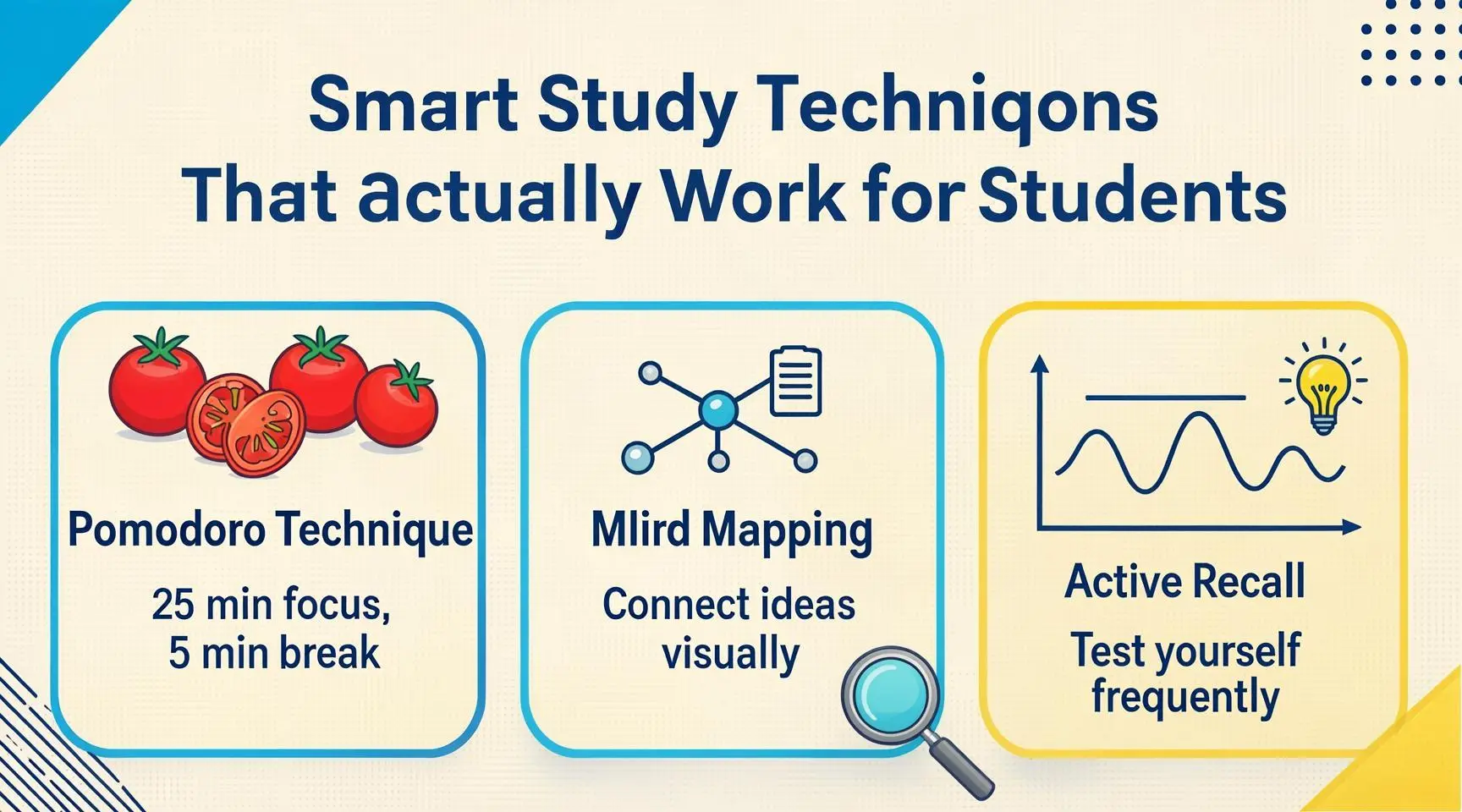
1. Active Recall
One of the most effective ways to learn is to test yourself instead of repeatedly reading the same chapter. This method is called Active Recall, and it helps your brain remember information for a much longer time.
How to Use It
After reading a topic, close your book and try to explain everything you remember without looking at your notes. You can also write down key points or use flashcards with questions on one side and answers on the other.Don’t worry if you forget some points—that’s actually part of the learning process. Every time your brain works to retrieve information, your memory becomes stronger. Over time, recalling answers during exams becomes much easier.
2. Spaced Repetition
Many students study a chapter once and never look at it again until the exam. Unfortunately, our brain naturally forgets information over time. Spaced Repetition solves this problem by reviewing the same topic at regular intervals.
How to Use It
Instead of revising everything the night before an exam, review a new topic after one day, then again after three days, a week later, and finally after a month.These short revision sessions help move information into your long-term memory, so you remember it when you need it most. Apps like Anki or a simple revision timetable can make this technique easy to follow.
3. Pomodoro Technique
It’s difficult to stay fully focused for several hours without getting distracted. The Pomodoro Technique helps you concentrate by breaking your study time into short, productive sessions.
How to Use It
Study with complete focus for 25 minutes, then take a 5-minute break. During the break, stretch, drink some water, or take a short walk. After completing four study sessions, take a longer break of 15 to 30 minutes.This method keeps your mind fresh, reduces mental fatigue, and makes it easier to stay motivated throughout the day.
4. Mind Mapping
If you find traditional notes boring or difficult to revise, try creating mind maps. They help you organize information visually, making complex topics easier to understand.
How to Use It
Write the main topic in the center of a blank page and draw branches for important ideas, definitions, formulas, dates, or examples. Use different colors, symbols, and keywords to make the map more interesting.Mind maps work especially well for subjects like Biology, History, Geography, and Economics, where different concepts are connected with each other.
5. Feynman Technique
A simple way to check whether you truly understand a topic is to teach it to someone else. This method, known as the Feynman Technique, focuses on learning through explanation.
How to Use It
Choose a topic you’ve studied and explain it as if you’re teaching a younger student or someone with no background knowledge. Use simple language and avoid memorized textbook definitions.If you get stuck or can’t explain something clearly, that’s a sign you need to revise that part again. Once you can explain a concept in simple words, you’ve understood it properly—and you’re much more likely to remember it in the exam.
6. Solve Previous Year Question Papers
One of the smartest ways to prepare for exams is by solving previous years’ question papers. No matter which board you belong to—CBSE, ICSE, State Board, IB, or Cambridge—past papers give you a clear idea of what to expect in the actual exam.
How to Use It
Don’t wait until the final revision to start practicing old papers. As soon as you complete a chapter or unit, solve questions related to that topic from previous years’ papers.This helps you become familiar with the exam pattern, understand the types of questions that are frequently asked, and improve your time management. It also builds confidence because you’ll know how to apply what you’ve learned in a real exam setting.
7. Prepare Short Revision Notes
Reading an entire textbook again just before the exam is not practical. That’s why creating short revision notes throughout the year can save you a lot of time later.
How to Use It
After finishing each chapter or at the end of every week, write down the most important points in your own words. Use bullet points, flowcharts, tables, diagrams, or simple mnemonics to make the information easier to remember.Keep all your revision notes in one notebook or folder. During the final days before the exam, these notes will help you revise important concepts quickly without feeling overwhelmed.
8. Teach What You Have Learned
A great way to check whether you’ve really understood a topic is to teach it to someone else. Explaining concepts forces you to think clearly and identify areas where your understanding is weak.
How to Use It
Teach a chapter to a friend, a sibling, or even explain it aloud to yourself. Try to use simple language instead of memorized textbook definitions.If someone asks a question that you can’t answer, you’ll know exactly which part needs more revision. Studying in small groups can also be helpful, as each student can explain different topics and learn from one another.
9. Remove Distractions While Studying
Even the best study plan won’t work if you’re constantly distracted. Notifications, social media, and frequent interruptions make it difficult to stay focused and reduce your productivity.
How to Use It
Keep your phone away from your study table or switch it to silent mode while studying. If you’re using a computer for online learning, avoid opening unnecessary websites or social media apps.Choose a quiet and comfortable place where you can study without interruptions. A clean and organized study space helps your brain stay focused and makes it easier to build a regular study routine.
10. Take Care of Your Health
Good health plays an important role in effective learning. Studying all night before an exam may seem like a good idea, but it usually leads to poor concentration and lower memory retention the next day.
How to Use It
Try to get 7–8 hours of sleep every night, especially during exam time. Drink enough water throughout the day, eat healthy foods like fruits, nuts, and vegetables, and avoid skipping meals.Adding a little physical activity, such as a 20-minute walk or light exercise, can also improve concentration and reduce stress. When your body feels healthy, your mind performs better, making studying easier and more productive.
Final Thoughts
Smart studying isn’t about spending every waking hour with your books—it’s about making every study session count. By using techniques like active recall, spaced repetition, practice papers, revision notes, and maintaining a healthy routine, you can learn more efficiently and feel more confident before your exams.
Start with one or two of these techniques and make them part of your daily routine. Small changes in the way you study today can lead to much better results tomorrow.
Daily Smart Study Routine
Having a study plan for exam success is crucial. Here is an example of a balanced daily routine that a student from Class 9 to 12 can adapt:
6:00 AM – 6:30 AM: Wake up, hydrate, light exercise or yoga.
6:30 AM – 8:30 AM: Study Session 1 (High difficulty subject like Math or Physics). Use Pomodoros.
8:30 AM – 3:00 PM: School/College Hours.
3:00 PM – 4:00 PM: Lunch, relax, take a power nap if needed.
4:00 PM – 5:30 PM: Homework and school assignments.
5:30 PM – 6:30 PM: Evening break (Sports, music, hobbies, family time).
6:30 PM – 8:30 PM: Study Session 2 (Medium difficulty subject like Chemistry or History). Active recall and spaced repetition.
8:30 PM – 9:00 PM: Dinner.
9:00 PM – 9:45 PM: Study Session 3 (Easy subject or reading/light revision).
9:45 PM – 10:30 PM: Wind down, pack your bag, plan the next day.
10:30 PM: Sleep.
Common Study Mistakes Students Should Avoid
Using the right study techniques is important, but avoiding common mistakes is just as important. Many students work hard but don’t get the expected results because of a few habits that slow down their learning.
Reading Without Understanding
Simply reading a chapter from beginning to end isn’t enough. If you’re not actively thinking about what you’re reading, chances are you’ll forget most of it later.
What to do instead: Read slowly, ask yourself questions, and note down the main ideas in your own words. Keeping a pen and notebook nearby can help you stay focused.
Highlighting Too Much
Highlighting every other sentence may make your book look colorful, but it doesn’t make revision easier. When everything is highlighted, it’s difficult to identify what’s actually important.
What to do instead: Highlight only important definitions, formulas, dates, keywords, or points that you often forget.
Keeping Your Phone Nearby
Checking your phone “just for a minute” can easily turn into a long distraction. Even notifications you don’t open can break your concentration.
What to do instead: Keep your phone away from your study table or switch on Do Not Disturb mode while studying. You’ll be surprised by how much more you can get done.
Skipping Regular Revision
Many students study a topic once and assume they’ll remember it forever. Unfortunately, that’s not how memory works.
What to do instead: Revise your lessons regularly. Even a quick review every few days helps you remember concepts for a much longer time and reduces exam stress.
Depending on Last-Minute Study
Trying to finish the entire syllabus a day or two before the exam usually creates unnecessary pressure. It also leaves very little time to understand difficult topics.
What to do instead: Study consistently throughout the year. Even one or two focused hours every day are far more effective than long study sessions just before the exam.
Best Apps to Help You Study Smarter
Technology can make studying easier when used wisely. These apps help you stay organized, revise regularly, and avoid distractions.
Google Keep or Microsoft OneNote
These apps are perfect for writing quick notes, creating checklists, and saving important information. Since everything is stored online, you can access your notes from your phone, tablet, or computer whenever you need them.
Notion
If you like keeping everything in one place, Notion is a great option. You can manage your study timetable, track your syllabus, plan assignments, and organize your notes without switching between multiple apps.
Forest
If staying away from your phone is a challenge, Forest can help. Every time you start a study session, you grow a virtual tree. Leaving the app before your session ends causes the tree to wither, making it a fun way to stay focused.
Quizlet
Quizlet helps you create digital flashcards and practice important questions. It’s especially useful for learning definitions, formulas, vocabulary, and facts through self-testing.
Anki
Anki is one of the best apps for long-term revision. It uses spaced repetition to remind you to review information just before you’re likely to forget it, making it ideal for subjects that require a lot of memorization.
Choose Study Techniques That Match Your Learning Style
Every student learns differently. Understanding how you learn best can make studying more enjoyable and effective.
Visual Learners
If you remember information better through images, focus on diagrams, flowcharts, mind maps, color-coded notes, and educational videos. Visual learning works especially well for subjects with processes and concepts.
Auditory Learners
If listening helps you learn, try reading your notes aloud or recording them and listening later. Group discussions, classroom explanations, and educational podcasts can also improve your understanding.
Reading and Writing Learners
If you learn best by reading and taking notes, rewrite important concepts in your own words. Make summaries, create lists, and solve written practice questions to reinforce your learning.
Kinesthetic Learners
If you enjoy learning through hands-on activities, include practical exercises in your study routine whenever possible. Use flashcards, perform science experiments, draw diagrams, solve problems on paper, or walk around while revising important answers. Staying physically involved can make learning easier to remember.
Remember
There isn’t a single study method that works for everyone. The key is to experiment with different techniques and find the combination that suits you best. Once you discover what works for your learning style, studying becomes more effective, less stressful, and much more rewarding.
How to Stay Motivated During Exams
Let’s be honest—staying motivated throughout exam season isn’t easy. Almost every student starts with enthusiasm, but after a few days, the excitement fades and procrastination begins to creep in. That’s completely normal. The secret isn’t finding endless motivation; it’s building small daily habits that keep you moving forward, even on days when you don’t feel like studying.
Set Small, Achievable Goals
Looking at an entire syllabus can feel overwhelming. Instead of telling yourself, “I have to finish Mathematics today,” break it into smaller tasks.
For example, decide to solve ten algebra questions, revise one history chapter, or learn five chemistry formulas in the next 30 minutes. Completing small goals gives you a sense of achievement and makes the next task feel less intimidating.
Reward Your Progress
Studying doesn’t have to feel like a punishment. After finishing a challenging topic, give yourself a small reward.It could be your favorite snack, a short walk, listening to music, or spending fifteen minutes on social media. These little breaks refresh your mind and make it easier to return to your books with renewed energy.
Keep Track of What You’ve Finished
One habit that many successful students follow is maintaining a simple checklist. Every time you complete a chapter or finish a practice paper, tick it off.Seeing your progress grow day by day is surprisingly motivating. It reminds you that you’re moving forward, even if the journey feels slow.
Don’t Compare Yourself With Others
Every classroom has that one student who seems to finish everything before everyone else. It’s easy to compare yourself, but it rarely helps.Some students learn quickly, while others need more time to understand concepts deeply. What matters isn’t how fast someone else studies—it’s how consistently you stick to your own plan.
Focus on Progress, Not Perfection
There will be days when you don’t complete everything you planned, and that’s okay. Instead of thinking about what you couldn’t do, look at what you’ve already accomplished.A positive mindset doesn’t mean pretending everything is perfect. It means accepting today’s progress and preparing to do a little better tomorrow.
Quick Revision Tips Before Exams
The last two days before an exam can make a real difference—provided you use them wisely. This isn’t the time to learn completely new topics. It’s the time to strengthen what you’ve already studied.
Revise Using Flashcards
Flashcards are perfect for quick revision. Use them to review formulas, definitions, important dates, vocabulary, or scientific terms.Since each card contains only one question or concept, you can revise a large amount of information in a short time.
Make a One-Page Summary
Try writing the most important formulas, diagrams, equations, or key points on a single sheet of paper.You won’t carry it into the exam hall, but creating it helps organize your thoughts. Many students remember information simply because they wrote it down themselves.
Attempt a Mock Test
If possible, solve one full-length sample paper under actual exam conditions. Set a timer, avoid distractions, and don’t pause midway.Apart from testing your knowledge, mock tests improve speed, accuracy, and confidence. They also show you which topics still need a quick revision.
Go Through Previous Years’ Papers
Spend some time looking at questions from previous exams. You may notice that certain concepts appear repeatedly, even if the questions are framed differently.Recognizing these patterns helps you prioritize your final revision.
Trust Your Revision Notes
In the final hours before an exam, avoid opening a new reference book or watching lengthy lectures on unfamiliar topics.Instead, revise the short notes you’ve prepared throughout the year. They’re already familiar, easy to understand, and much more useful at this stage.
Conclusion
There isn’t a magic formula for scoring high marks, and there certainly isn’t a shortcut. Good results usually come from doing simple things consistently—studying regularly, revising on time, practicing questions, and taking care of your health.Over the years, one thing has become clear: students who study with a plan almost always perform better than those who simply study for longer hours. Two focused hours with complete concentration are often more valuable than six hours spent reading without attention.Whether you’re preparing for CBSE, ICSE, a State Board examination, IB, Cambridge, or a competitive entrance exam, these study techniques can help you learn more effectively and reduce unnecessary stress.
Don’t try to change your entire routine overnight. Start with one or two techniques that suit your learning style. Use them consistently for a few weeks, observe the difference, and gradually build better study habits.Remember, success in exams isn’t about being the smartest student in the class. It’s about showing up every day, staying consistent, and making every study session count. Those small efforts, repeated over time, are what eventually lead to big results.
Frequently Asked Questions (FAQs)
1. What are the best smart study techniques?
From my experience working with students and observing different study habits, the most effective techniques are those that make your brain actively engage with the subject instead of simply reading it. Active Recall, Spaced Repetition, the Pomodoro Technique, and the Feynman Technique consistently deliver better results because they improve understanding and long-term memory.
For example, instead of reading a science chapter three times, try closing the book and explaining the topic in your own words. You’ll quickly discover what you know well and what still needs revision.
2. How can I study effectively every day?
The key is consistency, not perfection. Start your day with a realistic study plan instead of an overly ambitious timetable that you’ll struggle to follow.Choose two or three priority tasks, study in focused sessions, keep distractions away, and spend a few minutes at the end of the day reviewing what you’ve learned. Even on busy days, one productive study session is better than forcing yourself to sit with books for hours without concentration.
3. What is Active Recall?
Active Recall is a study technique where you test your memory instead of repeatedly reading your notes.For instance, after finishing a chapter, close the textbook and try to explain the topic without looking at it. You can write down important points, answer practice questions, or use flashcards. At first it may feel challenging, but that’s exactly why it works. Every time your brain retrieves information, it strengthens your memory.
4. What is Spaced Repetition?
Spaced Repetition is a revision method that helps you remember information for a longer period by reviewing it at planned intervals.Rather than revising everything the night before an exam, review a topic after one day, then after three days, a week later, and again after a few weeks. This simple habit reduces forgetting and makes revision much easier as exams approach.
5. Is the Pomodoro Technique useful?
Yes, it can be very effective, especially if you struggle to stay focused.The idea is simple: study with full concentration for 25 minutes, take a short five-minute break, and then begin another session. After completing four sessions, take a longer break.Many students find this method less tiring because it keeps the mind fresh and makes long study sessions feel more manageable.
6. How many hours should students study?
There isn’t a single answer that works for everyone. The ideal study time depends on your class, subjects, learning speed, and upcoming exams.A younger student may only need one or two focused hours each day, while students preparing for board exams or competitive exams may require more time. Instead of counting hours, focus on how productive those hours are. Three hours of focused study often produce better results than six hours filled with distractions.
7. How can I improve my memory for exams?
Improving memory is more about building good habits than finding shortcuts.Revise regularly instead of waiting until the last minute, test yourself often, get enough sleep every night, stay hydrated, and eat nutritious meals. Visual tools such as mind maps and diagrams can also make difficult topics easier to remember.
The more actively you use information, the longer you are likely to remember it.
8. Which study method works best for board exams?
Board exams require both conceptual understanding and regular practice.A balanced approach works best. Study each chapter carefully, test yourself using Active Recall, solve previous years’ question papers, and prepare short revision notes for the final weeks before the exam.Students who combine these methods usually feel more confident because they’re familiar with both the syllabus and the exam pattern.
9. What are the best revision techniques before exams?
Effective revision isn’t about reading every page again. It’s about reviewing important information in a smart and organized way.Use flashcards for formulas and definitions, revise your short notes, solve one or two mock tests under timed conditions, and go through previous years’ question papers. If you’re able to explain a difficult topic to someone else without referring to your book, it’s usually a good sign that you’ve understood it well.
10. How can students avoid procrastination?
Procrastination affects almost every student at some point. The easiest way to overcome it is to stop thinking about the entire syllabus and simply begin with one small task.Tell yourself you’ll study for just ten minutes or solve five questions. Once you get started, continuing becomes much easier.It also helps to keep your phone away while studying, maintain a clean study space, and break large chapters into smaller, manageable goals. Small, consistent progress every day is far more effective than waiting for the “perfect” mood to study.