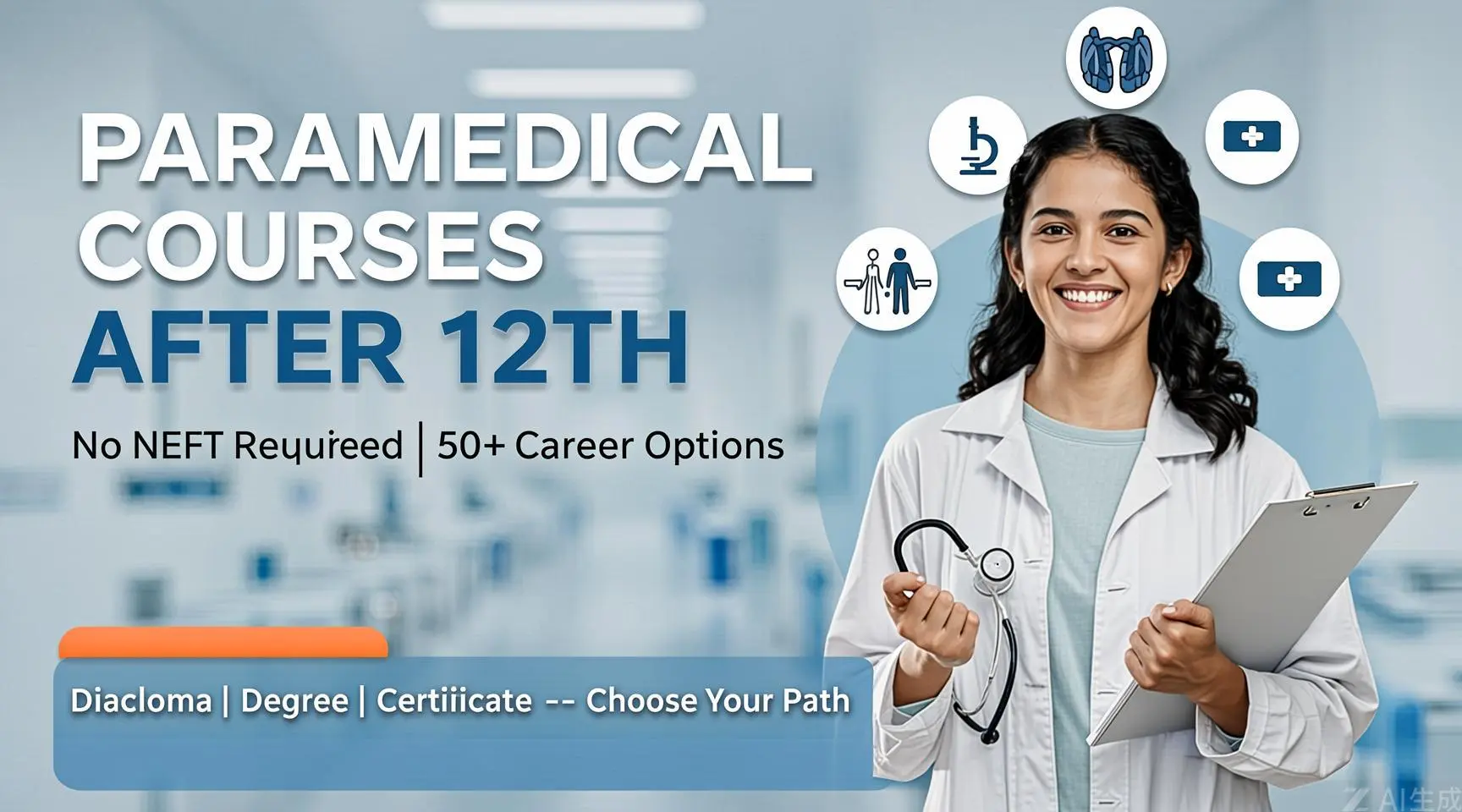
Selecting a career path after Class 12 is among the most important decisions a student will ever have to make, and if you are looking into healthcare as a field and do not wish to take the challenging NEET-MBBS pathway, then there is a great and practical option in the form of paramedical courses.In this comprehensive guide, all your doubts and questions regarding paramedical courses will be addressed. This includes what they are, eligibility criteria, list of available courses along with fee structure and salary estimates, colleges, and admission process – so that you can take an informed decision for 2026.
What Are Paramedical Courses?
Paramedical courses are those healthcare courses that are intended to make the students eligible to work as assistants in the field of medicine, without obtaining an MBBS or BDS degree. Paramedical personnel assist doctors in diagnosing, treating patients, and providing physiotherapy services. They work in laboratory rooms of hospitals, operation theaters, scanning rooms, emergency rooms, and physiotherapy or dialysis rooms.
While pursuing an MBBS degree requires candidates to qualify NEET, paramedical courses do not demand NEET qualification, and are much cheaper and of a shorter duration.
Why Choose Paramedical Courses Over MBBS/NEET?
- No NEET required for most programs (some institutes may still ask for an internal or university-level entrance test)
- Shorter course duration — many programs finish in 6 months to 3 years, compared to 5+ years for MBBS
- Lower fees compared to medical degree programs
- Faster entry into the workforce with strong placement support at many institutes
- Wide specialisation choice — from lab technology and radiology to physiotherapy and optometry
- Consistent demand, since hospitals, diagnostic centres, and clinics always need trained support staff
- International opportunities in countries like the UK, Canada, and Gulf nations after proper credential evaluation and licensing
Eligibility Criteria
Eligibility varies slightly depending on the course level and specialisation, but here are the general requirements:
- Candidates should have passed Class 12 from a recognised board
- For most degree and diploma courses, Physics, Chemistry, and Biology (PCB) are required or strongly preferred
- A minimum of 45–55% marks in Class 12 is typically expected (relaxations are usually given for SC/ST candidates)
- Some certificate-level courses are open to students from Arts and Commerce streams as well, and don’t always require a science background
- A handful of diploma and certificate programs can even be started right after Class 10
- Top institutes (like AIIMS and other government medical colleges) may require candidates to clear a national or university-level entrance exam
List of Paramedical Courses After 12th (By Level)
1. Certificate Courses (Duration: 6 months – 1 year)
Ideal for a quick, job-focused entry into healthcare support roles.
- Certificate in Medical Laboratory Technology
- Certificate in ECG Technology
- Certificate in Dialysis Technology
- Certificate in Home-Based Health Care
- Certificate in First Aid & Emergency Care
2. Diploma Courses (Duration: 1 – 2 years)
A step up from certificate courses, offering more structured, technical training.
- Diploma in Medical Laboratory Technology (DMLT)
- Diploma in Radiology & Imaging Technology
- Diploma in Operation Theatre Technology (OTT)
- Diploma in Physiotherapy (DPT)
- Diploma in Ophthalmic Technology
- Diploma in Dental Hygiene
- Diploma in Anaesthesia Technology
3. Undergraduate (Degree) Courses (Duration: 3 – 4 years)
These are the most popular choice for students who want stronger career growth and higher starting salaries.
- BSc Nursing
- Bachelor of Physiotherapy (BPT)
- BSc Medical Laboratory Technology (BSc MLT)
- BSc Optometry
- Bachelor of Medical Radiology and Imaging Technology
- BSc Operation Theatre Technology
- BSc Dental Hygiene / Dental Operating Room Assistant
- BSc Cardiac Care Technology
- BSc Anaesthesia Technology
4. Postgraduate Courses (Duration: 2 years)
For those who want to specialise further or move into supervisory/teaching roles after completing an undergraduate paramedical degree.
- MSc Medical Laboratory Technology
- Master of Physiotherapy (MPT)
- MSc Radiology & Imaging Technology
- MSc Optometry
Fees Structure: Government vs Private Colleges
Fees for paramedical courses vary widely depending on the institution type, course level, and specialisation:
| Institution Type | Approximate Fee Range |
| Government colleges | ₹2,500 – ₹1.5 lakhs (full course) |
| Private colleges | ₹40,000 – ₹8 lakhs (full course) |
| Diploma/certificate programs (select institutes) | ₹21,000 – ₹66,000 |
However, the government schools are considerably less expensive, though seats are few and difficult to get. The private colleges might cost more but provide better facilities, hospital links, and job placements; thus, a comparison between both is highly recommended.
Top Paramedical Colleges in India
Some of the most recognised institutes offering paramedical courses include:
- AIIMS (multiple campuses)
- PGIMER, Chandigarh
- CMC Vellore
- RUHS (Rajasthan University of Health Sciences)
- NEIGRIHMS
- State government medical colleges and health universities (offer subsidised fees and strong government job eligibility)
Important: Before opting for any institute, it should be confirmed whether or not the institution has been accredited by the state paramedical council. The fees should never be the basis for opting for a particular institute; rather, other factors such as training and hospital tie-ups must be taken into consideration.
Admission Process
- Check eligibility — Class 10 or 12 marksheet (as applicable), meeting the minimum percentage requirement
- Shortlist colleges — compare government vs private options, course specialisations, and fees
- Apply online/offline — submit required documents (marksheets, ID proof, passport-size photos) along with the application fee
- Entrance exam (if applicable) — some top colleges require a national or university-level entrance test
- Merit list / counselling — admission is granted based on merit or entrance exam rank
- Fee payment & document verification — complete the admission formalities to confirm your seat
Career Scope & Salary
The demand for paramedical professionals is in constant supply in the developing healthcare industry in India and will see substantial growth in the future years ahead.
Average starting salaries (India):
- BSc Nursing graduates: ₹2.5 – 3.5 lakhs per annum
- Physiotherapists, Radiology Technicians, Lab Technicians: broadly similar ranges, with growth based on specialisation and experience
Career growth paths include:
- Senior technician / department in-charge roles in hospitals
- Specialisation through postgraduate study
- Government sector jobs (hospitals, health departments)
- Private diagnostic chains and corporate hospitals
- International opportunities in the UK, Canada, and Gulf countries after credential evaluation and licensing
Things to Check Before Choosing a Paramedical Course
- Is the college/course recognised by the relevant state paramedical council?
- Does the institute offer hospital tie-ups for practical/clinical training?
- What is the placement track record?
- Does the course specialisation match your interest and long-term career goals (not just the one with lowest fees)?
- Are there opportunities for further studies (PG) or international licensing later?
Frequently Asked Questions (FAQs)
Q1. Can I do a paramedical course after 12th without NEET?
Yes, most paramedical courses do not require NEET. Some top colleges may ask for their own entrance test, but NEET is not mandatory across the board.
Q2. Which stream is required for paramedical courses after 12th?
Most degree and diploma courses require Physics, Chemistry, and Biology (PCB). However, some certificate-level courses accept Arts and Commerce students too.
Q3. What is the minimum percentage required in Class 12 for paramedical courses?
Generally, 45–55% marks in Class 12 are required, though this can vary by college and course.
Q4. Which is the best paramedical course after 12th?
BSc Nursing, Bachelor of Physiotherapy (BPT), DMLT, BSc MLT, and BSc Optometry are among the most popular choices in terms of career opportunities and salary potential.
Q5. Can paramedical graduates work abroad?
Yes, graduates from recognised Indian institutions can work in countries like the UK, Canada, and Gulf nations after completing the required credential evaluation and licensing process.
Selecting a good paramedical course depends on the healthcare field you really like – whether it is laboratory sciences, imaging technology, physiotherapy or emergency services – and then selecting a credible course which will give you hands-on experience in that field. If you pick the right course for yourself, it is probably the best decision you could make as a Class 12 Science student in 2026.