
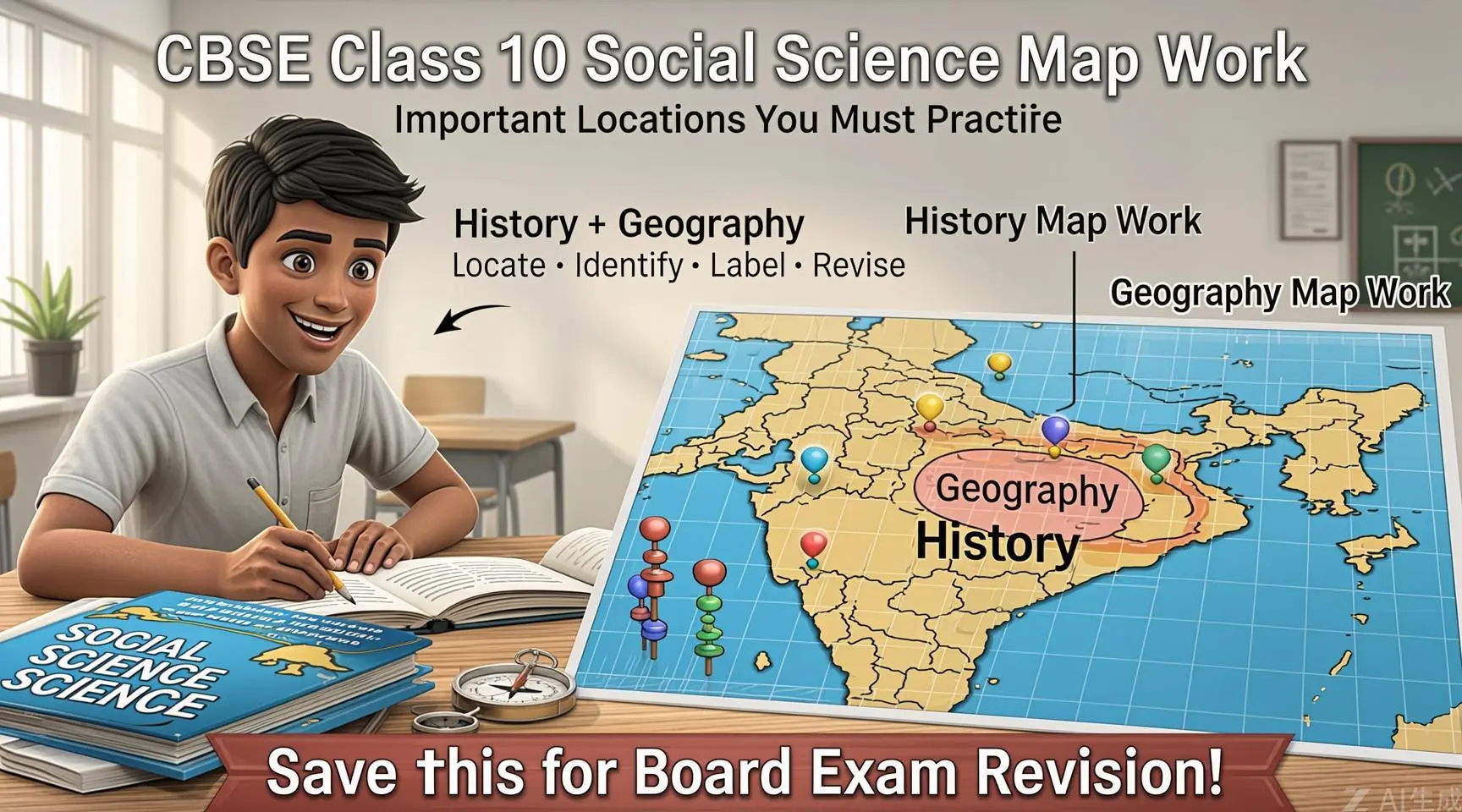
Welcome students! As a board exam mentor I can say with confidence that Map Work worth 5 markss the section that gives the most scores, in your CBSE Class 10 Social Science paper. You do not have to write answers. You just need a memory, accurate pointing and clean labels.
This guide follows the CBSE syllabus exactly. It is made to make your map practice easy, visual and focused on exams. Lets get those 5 marks!
CBSE Class 10 Social Science Map Work – Introduction
Why is Map Work important? Map questions test your spatial understanding of historical events and geographical phenomena. In History, it shows where events happened. In Geography, it connects resources, industries, and trade to specific locations.
How to prepare:
- Don’t cram blindly: Understand the state/region where a place lies.
- Locating vs. Identifying: “Locating” means you are given a name and you have to find it on a blank map. “Identifying” means a place is already marked on the map, and you have to name it. You must practice both!
- Routine Practice: Draw a small outline map of India daily and mark 3-4 items.
History Map Work (Nationalism in India)
Note: As per the latest CBSE syllabus, History map work is entirely from the chapter “Nationalism in India”.
Indian National Congress Sessions
1. Calcutta (Sept 1920)
- 🗺️ What to Locate/Identify: City of Calcutta (Kolkata)
- 📚 Related Chapter/Topic: Nationalism in India
- ⭐ Why It Is Important: The session where the Non-Cooperation Movement was officially launched.
- 🧠 Memory Tip: Calcutta is on the eastern coast (West Bengal) near the Bay of Bengal. “Calcutta Starts Non-Cooperation.”
2. Nagpur (Dec 1920)
- 🗺️ What to Locate/Identify: City of Nagpur
- 📚 Related Chapter/Topic: Nationalism in India
- ⭐ Why It Is Important: The session where the Non-Cooperation program was adopted and approved.
- 🧠 Memory Tip: Nagpur is exactly in the center of India. “Nagpur cements the Non-Cooperation.”
3. Madras (1927)
- 🗺️ What to Locate/Identify: City of Madras (Chennai)
- 📚 Related Chapter/Topic: Nationalism in India
- ⭐ Why It Is Important: Boycott of the Simon Commission was decided here.
- 🧠 Memory Tip: Madras is on the south-eastern coast (Tamil Nadu).
4. Lahore (1929)
- 🗺️ What to Locate/Identify: City of Lahore
- 📚 Related Chapter/Topic: Nationalism in India
- ⭐ Why It Is Important: Demand for “Purna Swaraj” (Complete Independence) was declared here.
- 🧠 Memory Tip: Lahore is in the northwest. “Lahore demands Liberty.”
Important Centres of Indian National Movement
5. Champaran (Bihar)
- 🗺️ What to Locate/Identify: Champaran
- 📚 Related Chapter/Topic: Nationalism in India (1917)
- ⭐ Why It Is Important: Gandhi’s first Satyagraha movement against the indigo planters.
- 🧠 Memory Tip: Champaran is in North Bihar, near the Nepal border. “Champaran = Gandhi’s First.”
6. Kheda (Gujarat)
- 🗺️ What to Locate/Identify: Kheda
- 📚 Related Chapter/Topic: Nationalism in India (1917)
- ⭐ Why It Is Important: Satyagraha against crop failure and plague relief.
- 🧠 Memory Tip: Kheda is in central Gujarat, near Ahmedabad.
7. Ahmedabad (Gujarat)
- 🗺️ What to Locate/Identify: Ahmedabad
- 📚 Related Chapter/Topic: Nationalism in India (1918)
- ⭐ Why It Is Important: Gandhi’s first hunger strike for cotton mill workers’ wages.
- 🧠 Memory Tip: Ahmedabad is in eastern Gujarat. “Ahmedabad = Mill Strike.”
8. Chauri Chaura (Uttar Pradesh)
- 🗺️ What to Locate/Identify: Chauri Chaura
- 📚 Related Chapter/Topic: Nationalism in India (1922)
- ⭐ Why It Is Important: Violent incident where protestors burned a police station, leading Gandhi to call off the Non-Cooperation Movement.
- 🧠 Memory Tip: It is in Gorakhpur district, eastern UP. “Chauri Chaura cancels the Movement.”
9. Dandi (Gujarat)
- 🗺️ What to Locate/Identify: Dandi
- 📚 Related Chapter/Topic: Nationalism in India (1930)
- ⭐ Why It Is Important: Endpoint of Gandhi’s Salt March (Civil Disobedience Movement) where salt law was broken.
- 🧠 Memory Tip: Dandi is a coastal village in South Gujarat (Surat). “Dandi = Salt.”
Geography Map Work
Geography map work is divided across three chapters: Resources and Development, Manufacturing Industries, and Lifelines of National Economy.
Soil/Crop Regions
- Major Cotton Growing Areas: Mark in Maharashtra (Vidarbha), Gujarat, and Punjab. (Black soil region).
- Major Wheat Growing Areas: Mark in Punjab, Haryana, and UP (Ganga plains).
Manufacturing Industries (Iron & Steel Plants)
- Bhilai: Chhattisgarh
- Bokaro: Jharkhand
- Durgapur: West Bengal
- Burnpur: West Bengal
- Rourkela: Odisha
- Jamshedpur: Jharkhand
- Vijayanagar: Karnataka
Software Technology Parks (STP)
- North: Srinagar, Lucknow, Gandhinagar
- West: Mumbai, Pune
- South: Bengaluru, Chennai, Hyderabad, Thiruvananthapuram
- East: Bhubaneswar
Ports (Lifelines of National Economy)
- West Coast: Kandla, Mumbai, Marmagao, New Mangalore, Kochi
- East Coast: Tuticorin, Chennai, Visakhapatnam, Paradip, Haldia
International Airports
- Delhi (IGI), Mumbai (Chhatrapati Shivaji), Bengaluru, Chennai, Thiruvananthapuram, Hyderabad.
Quick Revision Table
| Location/Feature | Subject | What to Mark | State/Region | Importance |
|---|---|---|---|---|
| Dandi | History | Place | Gujarat | Salt March endpoint |
| Champaran | History | Place | Bihar | First Satyagraha |
| Chauri Chaura | History | Place | Uttar Pradesh | NCM withdrawal |
| Nagpur | History | City | Maharashtra | INC Session 1920 |
| Bhilai | Geography | I&S Plant | Chhattisgarh | Major steel producer |
| Bokaro | Geography | I&S Plant | Jharkhand | Major steel producer |
| Kandla | Geography | Sea Port | Gujarat | Tidal port |
| Paradip | Geography | Sea Port | Odisha | Port for iron ore export |
| Bengaluru | Geography | STP / Airport | Karnataka | Silicon Valley of India |
| Srinagar | Geography | STP / Airport | J&K | Northernmost STP |
Final Revision Checklist
Before you sit for your exam, ensure you have checked these off:
- Practice the blank India map 5 times.
- Revise all History INC sessions and movement centers.
- Revise Geography I&S plants and STPs.
- Practice locating places without looking at your notes.
- Check the spelling of place names (e.g., Chauri Chaura, not Chauri Chaura; Marmagao, not Marmagoa).
- Practice neat and accurate labelling using a pencil.
- Revise the official CBSE map-work list provided by your teacher before the exam.
Memory Tricks for Geography
- Steel Plants Trick:“Bhai Bhai De Do Bhai Bhai” → Bhilai, Bokaro, Durgapur, Durgapur(Burnpur), Burnpur, Bokaro(Jamshedpur), Bokaro/Rourkela, Bokaro (Salem/Vijayanagar). (A bit confusing, try this instead):
- Better Trick: “J B B D R B S V” → Jamshedpur, Bokaro, Bhilai, Durgapur, Rourkela, Burnpur, Salem, Vijayanagar.
- West Coast Ports: “K M M N K” → Kandla, Mumbai, Marmagao, New Mangalore, Kochi. (Trick: “Karodo Money Mangta New Koti”)
- East Coast Ports: “T C V P H” → Tuticorin, Chennai, Visakhapatnam, Paradip, Haldia.
Most Important Locations for Revision
Disclaimer: This is based on past exam trends and high-yield topics. Always prepare the entire syllabus.
History:
- Dandi (Salt March)
- Champaran / Kheda
- Chauri Chaura
- Lahore Session
Geography:
- Iron & Steel Plants: Bhilai, Jamshedpur, Bokaro
- Software Technology Parks: Bengaluru, Srinagar, Lucknow
- Ports: Kandla, Paradip, Haldia
- International Airports: Thiruvananthapuram, Hyderabad
Exam-Day Tips
- Read First: Before touching your map, read the question carefully. Note whether it is a History map (usually single state/event focus) or Geography map (mixed features).
- Use a Scale: Draw straight lines for highways/airports. Use a pencil and scale to draw a small symbol.
- Arrow Technique: If there are two places close to each other (e.g., Ahmedabad and Kheda), mark the place with a dot, draw a small arrow line outward, and write the name outside to avoid overlapping.
- Neatness Counts: Erase extra pencil marks. A clean map fetches full marks.
Frequently Asked Questions (FAQs)
Q1. Is it necessary to use symbols. Can I just write the place name?
A1: Yes CBSE expects symbols (for example a square for an industry a dot for a city). Writing the name without a dot or symbol will lead to a reduction in marks.
Q2. Can I use a pen to label the map?
A2: No you must use a sharpened HB pencil for both marking and writing names on the outline map.
Q3. What if I mark a place off from the exact point?
A3: If it is within the state or region examiners usually accept it. However if the location is very wrong (for instance marking an Indian port in North India) you will get no marks.
Q4. Will the map question have. Locating tasks?
A4: The CBSE paper usually has two parts: 2 marks for locating (you find the place) and 3 marks for identifying (they give a map with marked features you name them). Be ready, for both.
Conclusion
Map Work is your opportunity to secure 5 out of 5 marks without writing paragraphs. Treat map as a story of Indias freedom struggle and its economic geography.Practice daily. Draw arrows neatly. Memorize spellings. Walk into the exam hall, with confidence. You have this!
Related Topics:
- CBSE Board Question Bank for Class 10 Mathematics PDF Download
- CBSE Board Question Bank for Class 10 Science PDF Download
- CBSE Class 10 Maths Important Questions: Chapter-Wise
- CBSE Class 10 Science Important Questions Chapter Wise (2026-27) | Free PDF
- Weak Subject in Class 10? How to Fix It in 6 Months
Last Updated on September 10, 2026