
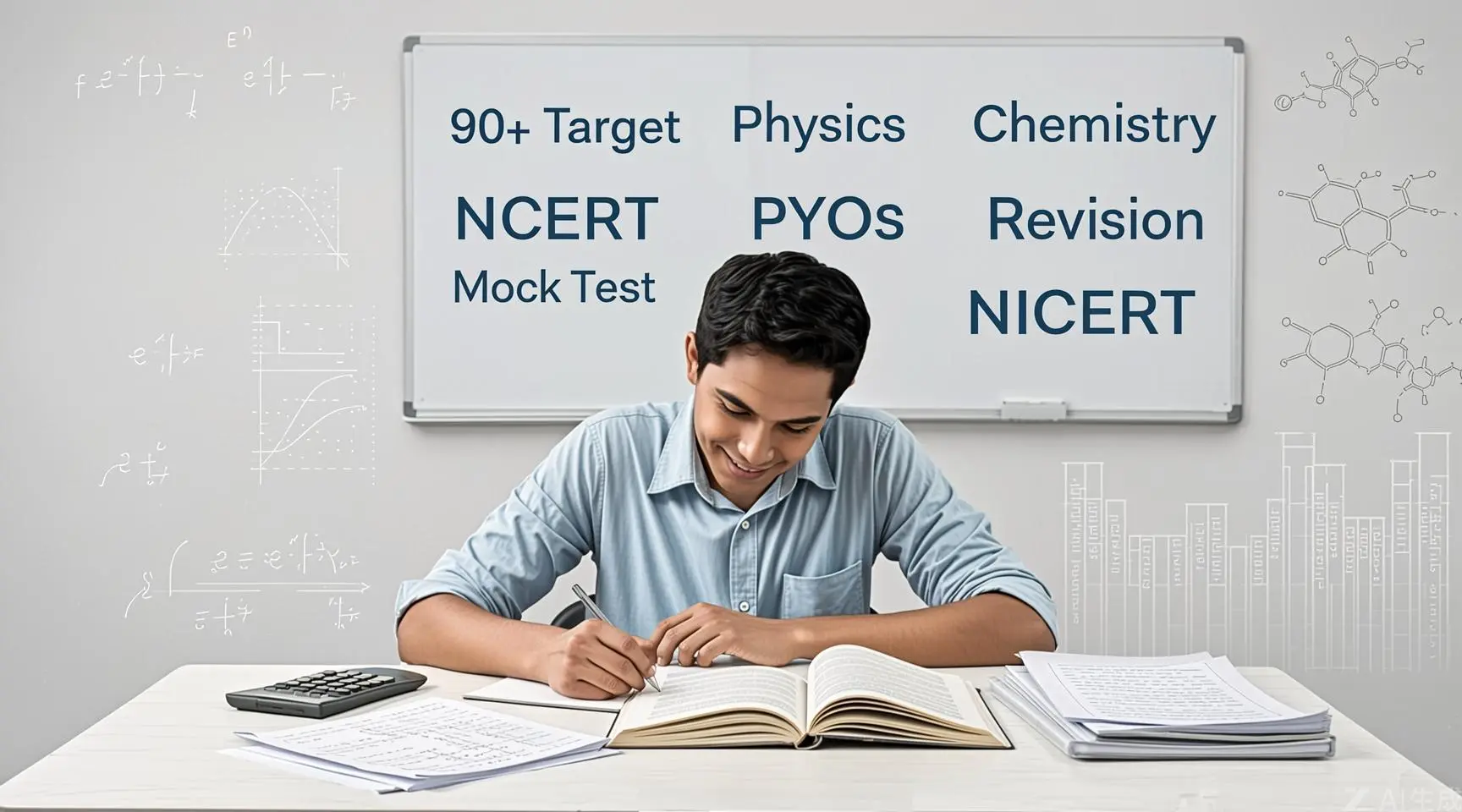
It is possible for a CBSE Class 12 board student to score above 90 in his/her exams if s/he adopts a strategic preparation strategy. This is something that many students have failed to do as a result of treating Physics and Chemistry like any other theoretical subject that one can cram the day before the test. To get past the 90 mark barrier, a mind shift is essential.
If you want to know how to score 90 marks in class 12 physics chemistry, the solution is the integration of clear concept knowledge and practical applications. You need to be very good at analysis and numerical problem solving in Physics. On the other hand, you need to be good at both memorizing and applying concepts of NCERT in Chemistry.
In this post, we will provide you with an all-subject wise approach for scoring 90 marks in physics and chemistry.
Why 90+ Is Achievable in Physics and Chemistry
The board exam question paper is highly dependent on NCERT syllabus. As against other competitive exams where knowledge of obscure concepts is essential, board exams will favor those candidates who have mastered NCERT books completely, write answers beautifully, and solve standard numerical problems easily.
The main distinction between preparation of these two subjects lies in:
Physics: A subject that is highly logic, derivation, and numerical-based. There is no escaping Physics by cramming.
Chemistry: A combination of theoretical and application aspect of Inorganic, Physical and Organic chemistry respectively. NCERT reading in detail is a must here.
A score of above 90 is inevitable by following NCERT thoroughly along with PYQs and revision regularly.
How to Score 90+ in Class 12 Physics
Class 12 Physics is a very difficult subject because of its extensive syllabus and numerical nature. But, having an effective Class 12 Physics preparation strategy, you can make it easy for yourself and score well in it.
Physics Chapter-wise Study Plan
Electrostatics and Current Electricity: Make sure that you put much emphasis on derivations (Gauss’s Law, Kirchhoff’s Law), and circuit diagram. Practice numericals based on equivalent resistance and equivalent capacitance.
Magnetism and EMI: Learn the similarities between electrostatics and magnetism. Lenz’s Law, AC generator and transformer derivations are important.
Optics: Ray optics is a very scoring part. Learn all about ray diagrams of mirrors, lens, and prism. In wave optics, practice Young’s double-slit and diffraction.
Modern Physics: It is the highest scoring topic. Learn about photoelectric effect, nuclear physics, and semiconductor logic gate derivation. Don’t leave this topic until the end.
Physics Numerical-Solving Strategy
To score 90+, you cannot afford to skip numericals.
- Standard Formulae: Maintain a separate notebook for all chapter-wise formulas.
- Step-by-Step Approach: Always write Given, To Find, Formula, Substitution, and Answer with correct SI Units.
- Practice Variety: Solve all solved examples and exercises from NCERT. Follow up with Class 12 Physics PYQs to understand the typology of questions asked.
Physics Derivation & Diagram Strategy
Derivations: Never rote-learn derivations. Understand the starting principle (e.g., “Starting with Ampere’s Circuital Law…”). CBSE gives step marks. If you write the correct diagram and initial formula, you will secure partial marks even if you get stuck later.
Diagrams: Always draw neat, labeled diagrams using a pencil. For topics like Cyclotron, Galvanometer to Ammeter/Voltmeter conversion, and Logic Gates, diagrams are mandatory for full marks.
Physics Daily Study Routine
A realistic time schedule for Physics, for 2 hours per day:
- Theories and Derivations (30 minutes): Understand the theory and write the derivation.
- Formula Revision (10 minutes): Go through your formula notes.
- Numericals (40 minutes): Work out 5-7 numerical problems using NCERT and Exemplar.
- Previous Year Questions (40 minutes): Solve 3-4 PYQs on the topic that you studied today.
How to Score 90+ in Class 12 Chemistry
Chemistry is divided into three distinct sections, each requiring a different approach. Your Class 12 Chemistry preparation must reflect this diversity.
Physical Chemistry Strategy
- Focus: Numericals and formulas.
- Approach: Chapters like Solutions, Electrochemistry, and Chemical Kinetics carry significant weightage. Make a formula sheet. Practice solving numericals related to molarity, molality, Nernst equation, and rate constants.
- Practice: Solve all back-exercise numericals and intext questions from NCERT.
Organic Chemistry Strategy
- Focus: Mechanisms and named reactions.
- Approach: Do not memorize reactions blindly. Understand the electron-displacing effects (inductive, resonance, hyperconjugation). If you know the mechanism (e.g., nucleophilic substitution), you can predict the products of any reaction.
- Named Reactions: Write down all named reactions (Sandmeyer, Friedel-Crafts, Aldol, Cannizzaro) on a single sheet and revise them daily.
- Conversions: Practice organic conversions (e.g., Ethanol to Ethylamine) daily. They are high-scoring questions in the board exam.
Inorganic Chemistry Strategy
- Focus: Strict NCERT line-by-line revision.
- Approach: Chapters like p-block, d-block, and Coordination Compounds require intense memorization. Read the NCERT text like a novel. Pay special attention to tables, anomalous behaviors, and uses of compounds.
- Coordination Chemistry: Focus on IUPAC nomenclature, isomerism, and Valence Bond Theory (VBT). Crystal Field Theory (CFT) requires conceptual clarity for drawing energy level diagrams.
Chemistry Daily Study Routine
A balanced routine of 2 hours for Chemistry:
- Physical Chemistry (45 mins): Read theory + solve 5 numericals.
- Organic Chemistry (45 mins): Learn 1 mechanism + practice 2-3 conversions.
- Inorganic Chemistry (30 mins): Read 3-4 pages of NCERT thoroughly and revise previous day’s notes.
Physics vs Chemistry: Preparation Comparison Table
To streamline your preparation, understand how to tackle both subjects differently:
| Parameter | Physics Preparation | Chemistry Preparation |
|---|---|---|
| Learning Method | Conceptual understanding + mathematical application | Divided into logic (Physical), mechanism (Organic), and memory (Inorganic) |
| NCERT Importance | Crucial for theory, derivations, and solved examples | Absolute Bible; every line is important, especially for Inorganic |
| Numerical Practice | High priority. Daily practice required. | Moderate priority. Restricted to Physical Chemistry. |
| Memorisation | Formulas, values of constants, and standard definitions | Reactions, exceptions, colors, formulas, and named reactions |
| PYQs Focus | To understand application of formulas in different scenarios | To identify frequently asked reactions and direct NCERT lines |
| Revision Method | Solving mixed numericals and rewriting derivations | Flashcards for reactions, daily reading of NCERT Inorganic |
| Answer-writing | Show all calculation steps, draw circuit/ray diagrams | Write balanced equations, highlight names of compounds/reactions |
30-Day Strategy to Score 90+ in Physics and Chemistry
If you have a month left and are wondering how to score 90+ in Class 12, follow this structured 30-day plan:
Days 1–10: Concept Building
- Focus entirely on NCERT. Complete all chapters that you find difficult.
- Make your formula sheets and reaction maps.
- Solve all NCERT back exercises.
Days 11–20: PYQs and Chapter-wise Practice
- Start solving Class 12 Physics PYQs and Chemistry PYQs from the last 5-7 years.
- Note down questions that you get wrong and revisit those concepts in NCERT.
- Practice sample paper questions topic-wise.
Days 21–25: Full Revision
- Do not pick up any new books. Stick to your notes and NCERT.
- Revise all Physics derivations and Chemistry named reactions daily.
- Solve 15-20 random numericals daily to maintain speed.
Days 26–30: Mock Tests and Error Correction
- Attempt full-length CBSE sample papers in a timed environment (3 hours).
- Evaluate your papers honestly. Identify where you are losing marks (e.g., missing units in Physics, unbalanced equations in Chemistry).
- Work entirely on presentation and time management.
How to Attempt the Physics and Chemistry Board Paper
Your exam presentation can make a difference of 5-7 marks. Here is how to attempt the paper:
- Reading Time (15 mins): Go through the paper carefully and identify those questions which are easy for you. Mark the questions you plan to attempt and think about your approach.
- Time Allocation: Allocate time for each section of the question paper. Avoid wasting 15 minutes on a 2-mark question. If you get stuck somewhere, leave the space and move on.
- Write Formulas: While attempting Physics numerical, remember to write the formula first. This will give you step marks.
- Show Your Workings: Never jump to the answer straight away. Write down substitution and calculation steps.
- Draw Labelled Diagrams: In Physics, you may be awarded 1 mark just for drawing a diagram, irrespective of how much the derivation has been completed. In Chemistry, always show the structures of conversion reactions.
- Underlining: Underline important terms, your final answers, and formulas. This will make it easier for the examiner.
- Long Answer Questions: Structure them properly and start with an introduction. Then proceed to the main explanation/derivation and finally provide a diagram/application.
- Checking for Errors: Use the last 10 minutes for checking SI units in Physics and balance of chemical equations in Chemistry.
Top Mistakes That Reduce Board Exam Marks
Even well-prepared students lose marks due to silly errors. Avoid these:
- Not Studying NCERT Text: Studying only reference books and neglecting NCERT text, especially in Chemistry.
- Memorizing Without Understanding: Memorizing Physics formulae without understanding them.
- Not Practicing Numericals: Reading numericals as theoretical problems without practicing them using pen and paper.
- Not Attempting PYQs: Thinking that the question will not be repeated. CBSE often sets similar questions in all the years.
- Not Time Managing Well: Spending much time on the beginning questions and leaving many high-scoring questions blank at the end.
- Forgetting Constants/Formulae: Not remembering the constants/formulae during the examination due to poor revision.
- Incomplete Answers: Giving one-line answers to 3 marks or 5 marks questions without giving diagram or explanation.
- Not Checking the Calculations and Units: Not writing SI unit in Physics or not balancing the equations in Chemistry.
90+ Marks Checklist for Class 12 Physics & Chemistry
- I have read the NCERT Chemistry textbook line-by-line, focusing on Inorganic exceptions.
- I have a dedicated formula notebook for Physics and a reaction map for Organic Chemistry.
- I can solve all NCERT solved examples and back-exercise numericals without looking.
- I have solved PYQs from the last 5 years for both subjects.
- I can write all major Physics derivations from memory with correct diagrams.
- I practice organic conversions and named reactions daily.
- I attempt at least one full-length mock paper per week under timed conditions.
- I always write SI units and balance chemical equations in my practice tests.
FAQs
- Is NCERT sufficient to get more than 90% marks in Class 12 Physics and Chemistry?
NCERT is absolutely sufficient for Chemistry. In the case of Physics, NCERT theory and derivations are very important, along with practicing numericals from some reference book.
- What is the number of hours I have to study Physics and Chemistry in class 12 daily?
For scoring more than 90%, it’s recommended that one needs to study Physics and Chemistry for about 2 to 2.5 hours and 1.5 to 2 hours per day, respectively.
- How to memorize Chemistry reactions for the board exams?
Don’t mug up, try to understand the reactions. Make notes on the basis of named reactions in organic chemistry, and then revise it daily for 15 minutes.
- How should one solve Physics numerical problems in the board exams?
Always mention ‘Given’, ‘To Find’, and ‘Formula’. Put values, compute, and always box your answers in SI units.
- Is solving PYQs important for Class 12 Physics and Chemistry?
Yes, very much. Practice PYQs of Class 12 Physics and Chemistry in the past 5-7 years, and you can understand the perspective of the examiner, recurring topics, and the actual difficulty level of the board exams.
- How to manage time during the Physics board examination?
First go through those questions you are most confident with. Always keep an eye on the time—approximately 1.5 minutes per 1 mark, and always reserve at least 30-35 minutes for 5 mark numerical problems. Keep at least 10 minutes for checking units and computation.
- Can I score 90+ in class 12 physics chemistry if I start my studies late?
Yes, if you have studied strategically. Start with high weightage chapters like Optics, Modern Physics, Electrochemistry, and p-block. Always be strict with NCERT and solve PYQs. Do not waste time on extra books.
Conclusion
Securing marks above 90 in your CBSE class 12th Physics and Chemistry is not an issue of studying 24 hours a day, but it is an issue of studying effectively. It just requires you to respect the NCERT syllabus, work on your numerical and reaction everyday and master your answer writing skills to make these your strong subjects. Just know that 90+ depends on your performance only.