
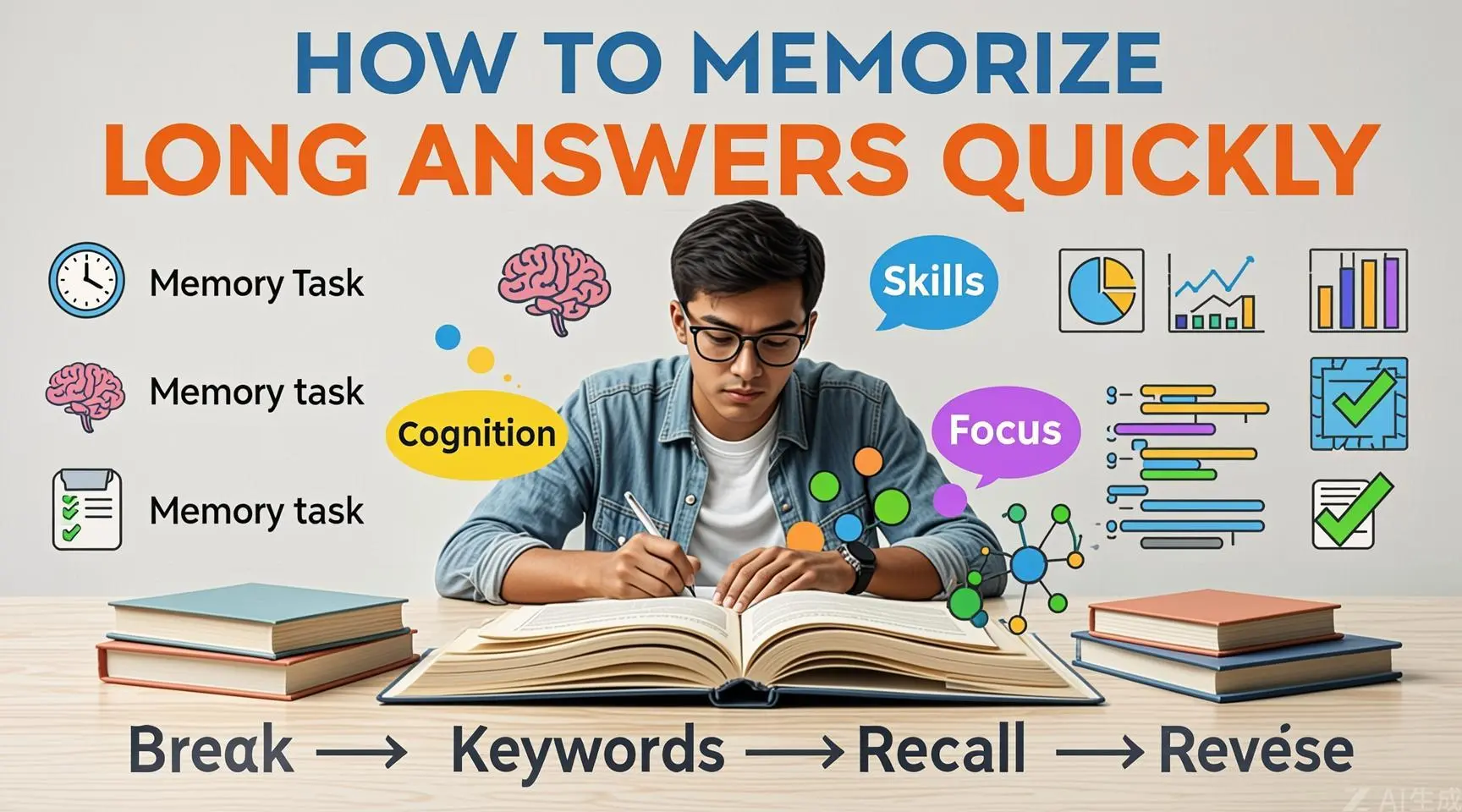
Are you staring at a massive 3-page answer in your History, Biology, or Business Studies textbook, wondering how you’ll ever remember it all for your board exams?As a study coach, I see students waste hours reading the same paragraph over and over, hoping it will magically stick in their brains. The good news is that memorizing long answers doesn’t require more time—it requires a better strategy.
Here is a practical, step-by-step guide to help you understand, remember, and reproduce lengthy answers quickly and easily.
Why Long Answers Are Difficult to Remember
It does not work to just re-read a lengthy answer as your brain interprets it as an endless wall of text. If you read without effort, you will have a “false confidence” that you know the text when in reality you only know the words you see in front of your eyes when you look at the book.
Your brain finds it difficult to store extensive information in an unstructured form. In order to memorize a lengthy answer, you should forget about remembering the words and focus on remembering the thoughts behind those words.
7 Fast Memorization Techniques
Here are 7 proven techniques to help you memorize long answers quickly:
1. The Keyword Technique
Memorize key words, not complete sentences. Read through a paragraph, and jot down 2-3 key words that convey its main idea. On the exam, your mind will automatically connect these key words to make complete sentences for you.
2. Chunking
Split a 10 point answer into smaller “chunks” of 3 points each. For instance, when you have 9 reasons for a particular event in history, split those into 3 chunks: Economic Reasons, Social Reasons, and Political Reasons. It is easier to remember 3 chunks of 3 than 9 points randomly put together.
- The Story Method
Make your keywords part of an outrageous story. The brain is more apt to recall stories than facts. If you have a list of events that you have to remember in a particular order, put them into a quick story in your mind.
- Mind Maps
Create a mind map of your answer. Write the central topic of the question in the middle of a blank page and create branches around that. You can put sub-branches with keywords in it. This will enable your brain to visualize the answer.
- Active Recall
Close the book and make yourself say or write down what you have just read. In case you find it difficult, then open the book, but then close it once more and start again. It’s this struggle that creates long-term memory.
- Spaced Repetition
Do not revise the answer 5 times on the same day. Revise the answer after 1 hour, then after a day, after 3 days, and after a week. This will tell your mind that “this piece of information is very important for me to remember.”
- Writing Practice
Write it down from your memory at least once. It is the process of writing that helps you build muscle memory. While you are sitting inside the examination hall, your hand will automatically try to write down the sequence of your answers.
Example: Turning a Long Answer into Keywords
Let’s say you have to memorize a long answer on the “Impact of Globalization on Indian Agriculture.”
Instead of memorizing full paragraphs, do this:
Step 1: Read and understand the text. Step 2: Extract the headings and keywords.
- Point 1: Globalization has shifted the focus from traditional crops to cash crops.
- Keywords: Shift, traditional to cash crops.
- Point 2: Farmers now have access to international markets to sell their produce.
- Keywords: International market access.
- Point 3: There is an increased exposure to modern technology like drip irrigation.
- Keywords: Modern technology, drip irrigation.
- Point 4: Indian farmers face heavy competition from subsidized foreign imports.
- Keywords: Competition, foreign imports.
Step 3: Memorize the keyword list: Cash crops, International markets, Modern tech, Foreign imports.
During the exam, all you have to do is write the heading, remember the keyword “Cash crops,” and write a full sentence explaining it. You save 80% of your memorization time using this method!
The 10-Minute Memorization Method
Got a long answer to memorize right now? Follow this exact 10-minute routine:
- Minutes 0-2 (Understand): Read the answer once carefully. Don’t try to memorize yet. Just understand the meaning.
- Minutes 2-4 (Extract): Grab a pencil and underline the main keywords in each paragraph. Write them in the margin.
- Minutes 4-6 (Map): Close the book. Draw a quick mind map or write the keywords on a rough paper in order.
- Minutes 6-8 (Recall): Look at your keywords and explain the answer out loud to yourself (or an imaginary friend) as if you were teaching them.
- Minutes 8-10 (Write): Without looking at the book, quickly scribble down the first letter of every keyword or write a rough outline of the answer. Check the book to see if you missed anything.
Exam-Day Revision Strategy
On the day of the exam, you don’t have time to read full paragraphs. Do this instead:
- Only Review Mind Maps & Keywords: Flip through your notes and only look at the visual maps, headings, and keyword lists you created.
- Skip Full Sentences: Do not read full sentences on exam day. It will only confuse you and make you panic.
- Brain Dumps: As soon as you get the question paper, use the first 5 minutes to write down tricky keywords or formulas on your rough sheet so you don’t forget them mid-answer.
Quick FAQ
Q: How many times should I revise a long answer?
A: Aim for 3-4 successful active recalls spaced out over a few days. Once you can write the keywords from memory without looking, you’ve got it.
Q: What if I forget a point during the exam?
A: Don’t panic. Move on to the next point you remember. Often, as you write the rest of the answer, the forgotten point will pop back into your head.
Q: Is it better to study out loud or silently?
A: Studying out loud (teaching an imaginary class) is highly effective because it forces you to process the information actively rather than passively reading it.
Conclusion
Long answer memorization is not about putting in more work; it’s about doing better work. Don’t keep reading the same paragraphs over and over again in an endless loop. Rather, try to pull out key phrases, create mind maps, and test yourself on the material.
Pick a hard long-answer question off of your syllabus right now and start using the 10-Minute Memorization Technique. You’ll be astounded by how quickly you’ll be able to memorize. Go for it!