- Posted on
- educationidol
- No Comments
- Education
- 141 Views
Table of Contents
ToggleIndia’s board exams, whether from CBSE, ICSE, or state boards, bring along with them a deluge of stress and anxiety. The minute the student steps into Class 10 or 12, a whole industry of coaching classes, home tuition, and crash courses rushes at him like floodwaters.
Let us just tell you the cold hard truth: Coaching is nothing more than an assistance in achieving excellence.
In fact, Relying entirely on coaching classes can make students passive learners who depend on being spoon-fed information instead of actively developing their own understanding. Studying by oneself makes the person an active learner, giving him/her a complete conceptual understanding, self-dependence, and time-management skills. These are not only necessary for acing the board exams but will prove helpful throughout his/her life in competitive examinations like JEE, NEET, or UPSC.
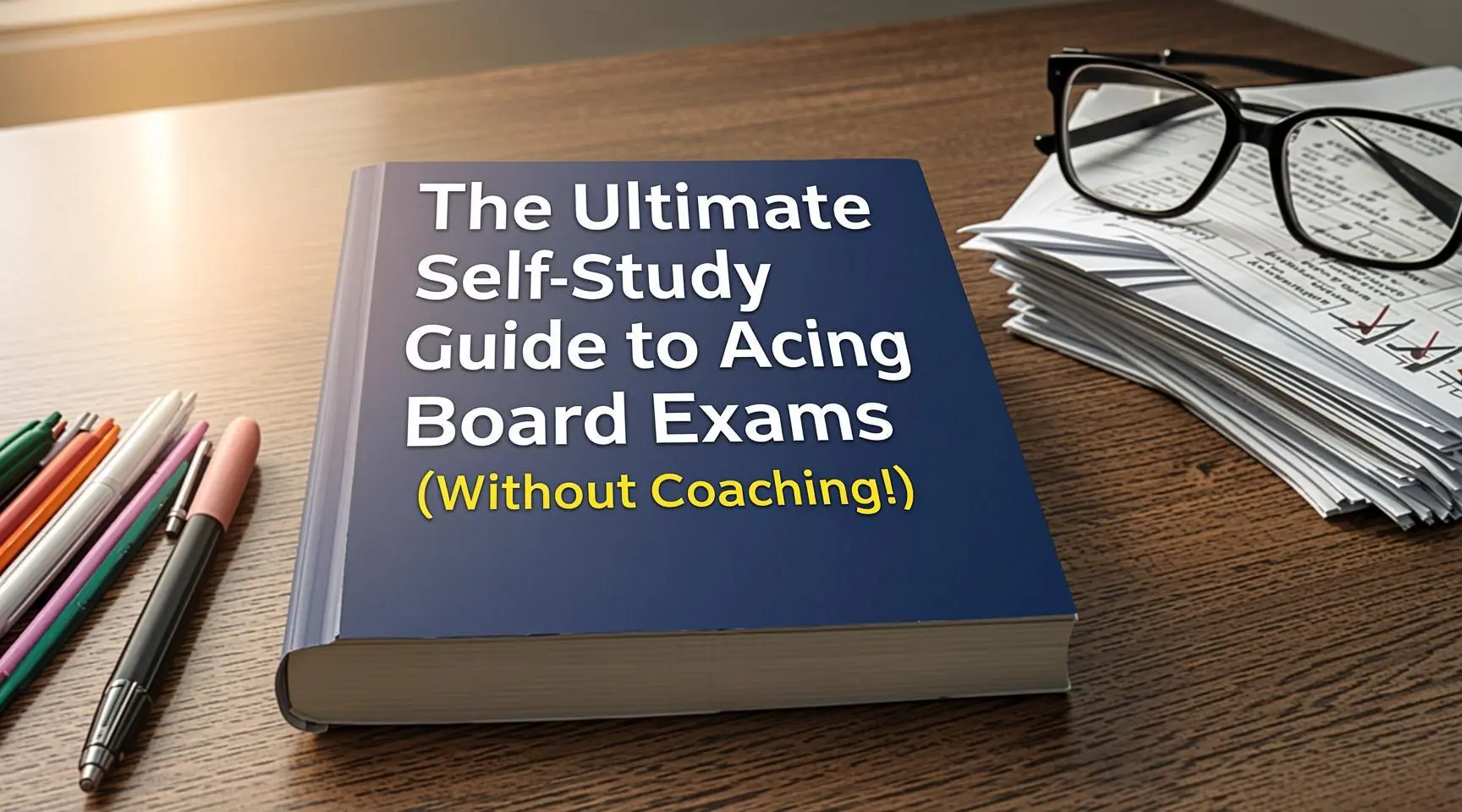
If you have decided to opt for self-study, then congratulations to you because you have taken up the difficult and extremely rewarding road. Here’s your foolproof, highly practical guide to prepare for your board examinations at home all by yourself, without relying on coaching classes.
Decode the Exam Pattern and Syllabus
Before you even start using your books, you must first familiarize yourself with the battleground. Most students fail not due to a lack of intelligence, but due to studying the wrong topics in the wrong manner.
Download the Official Documents: Just visit your board’s official website (cbse.gov.in for CBSE, cisce.org for ICSE). Download the latest syllabus document, the question paper design document, and the official marking scheme. Do not depend on any third party guessworks.
Understand the Weightage: The board gives a certain mark to certain units. For instance, in Class 12 Physics CBSE, “Optics” is marked 14, while “Dual Nature of Radiation and Matter” is given just 4 marks. Make a chart of all such weights. Your chart will determine the amount of time you devote to each chapter.
Cognitive Levels: Indian boards have moved a lot towards Competency-Based Questions (CBQs). Hence, rote learning will not help you score full marks anymore. You should be aware of the various cognitive levels: remembering, understanding, applying, analyzing, and evaluating. Case study and assertion-reasoning questions must get extra attention.
Track Your Progress with a Syllabus Checklist : Print the syllabus and hang it on your wall next to your study desk. When you finish a chapter, put a check mark next to it with a marker. This is a great psychological boost and visual proof of your progress.
Craft a Realistic, Dynamic Study Schedule
A simple timetable is always better than having no timetable at all. Don’t blindly copy a topper’s study routine from YouTube. You could be a morning person; a topper could be a night owl. Schedule to your natural body clock.
Time-Blocking and Task Listing: Don’t just write “Study Math from 10 to 1” but rather write “10:00 – 10:45: Complete NCERT Exercise 5.3”, “10:45 – 11:00: Break”, “11:00 – 11:45: Solve 10 MCQs from Quadratic Equations.” Micro-tasking is the best way to avoid procrastination.
Prioritize By Difficulty: The “Eat the Frog” method. Tackle the most difficult subject or chapter (your “frog”) first thing in the morning, when your willpower and concentration are at their peak. Leave lighter subjects, such as English or physical education, for the second half of the day when your brain is tired.
The 3:1 Ratio: For every 3 hours of learning new concepts, spend 1 hour just revising what you learned earlier in the week. If you simply take in new information and never review it, you will forget 80% of it in a week.
Sample Daily Block (Adaptable):
- 7:00 AM – 8:30 AM: Difficult Subject (e.g., Math)
- 8:30 AM – 9:00 AM: Breakfast & Break
- 9:00 AM – 10:30 AM: Medium Difficulty Subject (e.g., Chemistry)
- 10:30 AM – 11:00 AM: Break
- 11:00 AM – 12:30 PM: Theory Subject (e.g., History/Biology)
- 12:30 PM – 2:00 PM: Lunch & Power Nap (20 mins)
- 2:00 PM – 3:30 PM: Language (English/Hindi)
- 3:30 PM – 5:00 PM: Practice problems / PYQs
- Evening: Relax, exercise, no heavy studying.
Master Core Concepts (The NCERT/Textbook Bible)
Rote learning may work for you for your internal school tests, but it will definitely not work for you for the board exams, with the new pattern that is being implemented.
NCERT Supremacy (For CBSE Students): As a CBSE student, your NCERT books should be your primary study resource. Every line, every sidebar box, and even the summary given at the end of the chapter can become part of your exam syllabus. Read every line carefully of the chapter at least three times before switching to reference books.
Specifics for ICSE and State Boards: The prescribed textbooks (S. Chand, Concise, etc.) for ICSE should be taken into account first.
Use Free Online Learning Resources: No need for costly coaching modules. There is a wealth of free, quality education on the internet. Utilize YouTube channels such as Physics Wallah, Khan Academy India, Vedantu, and Unacademy. Only use these videos if you are stuck on a concept you do not understand in the book. Don’t assume into thinking that 2-hour video lectures can replace reading the book yourself.
The Feynman Technique: When you are done with a topic, close the book, explain the topic aloud without looking at the book and try to explain the concept in simple Hindi or your mother tongue aloud as if you are teaching it to a small kid. If you struggle or use convoluted jargon to hide your ignorance, you need to re-read the topic.
Effective Note-Taking for Quick Revision
Textbooks are for studying. Notes are for revision. If your notes are an exact copy of the textbook, then you have totally failed at making notes.
Cornell Notes Method: Break the page into three sections, where the left side is for keywords/questions, the right side is for notes in your own words, and a bottom section is for 2-line summarization of the entire page. This allows you to revise extremely quickly.
Formulas & Equations Mastery Sheets: If you are a student of mathematics, physics, or chemistry, keep a separate notebook for formula mastery. Review this notebook for 10–15 minutes every night before going to bed.
Flowcharts & Mind Maps: In the Indian Board Examinations, there are many times when you are asked to give steps of any process or describe any historical event. It is important that you create a flowchart of such processes/events. This could be the process of formation of urine in the nephron or steps towards the Quit India Movement.
When to Take Notes: Do not take notes while doing the first reading of the chapter. This would mean that you end up taking notes from the entire book. After the first reading, you have understood how the chapter progresses. The second reading is when you take notes.
Practice Regularly (The Active Recall Game)
Looking at a Mathematics solution and understanding it is not practice. Observing your teacher solve a physics numerical problem is not practice. Solving the problem yourself on paper is practice.
Solve Back Exercises First: Before going through any reference book like R.D. Sharma or Oswaal, make sure you have solved every single question from the back of your textbook. The Indian boards have a habit of either reproducing or slightly changing these same questions.
Avoid the “Tutorial Hell”: Do not be under the impression that you need to solve IIT-JEE level questions in order to get 95% in your boards. Your speed and accuracy will be tested in board exams. Solve only board-based question banks.
Write Your Answers, Not Only in Your Mind: While preparing for theoretical subjects, you must write down the answer. It helps you build muscle memory and improves your writing speed (which is important during a 3-hour exam) and gives you an idea on how to structure answers (Introduction, Body Points, and Conclusion).
Strategic Revision Strategies (Beating the Forgetting Curve)
Our brains is designed in such a way that we tend to forget the things that are not useful for us. The Ebbinghaus Forgetting Curve shows that we tend to forget about 70% of what we learn within the first 24 hours if we do not revise it.
Spaced Repetition: Revise new concepts on Day 1, Day 3, Day 7, and after one month. You can do this using the digital flashcard software like Anki which uses an algorithm designed specifically for spaced repetition or you can plan it in your schedule.
Blurting Technique: It is the secret weapon of Indian students. Take a blank sheet of paper. Select a topic say “Carbon and its compounds”. Set a timer for 10 minutes and start writing all about that topic without referring to your book. Once the time is over, take a red pen, open your book, and add whatever you have missed. This will clearly identify your weakness.
Weekly Revision Day: Select any day of the week like Sundays and use it only for revision. Don’t study new topics in this day. Review your formula sheets, mind mapping and blurting sheets.
Mock Tests and Performance Analysis
Knowledge of the answer is only half the battle; the presentation of that answer to the examiner in time-restricted conditions is the other half.
Create the Same Conditions as the Real Exam: Begin in January (for Feb/March exams), complete one previous year question paper or sample paper every day. Complete it on your desk without any without any distractions and following the exact 3-hour time frame.
Show Every Step Clearly: In case of subjects like Math and Physics, even if your answer is incorrect, you will score 80% of the marks if you follow the correct steps. Write all the formula and logical steps.
Presentation Of Answers: Write headings neatly, underline important keywords with a ruler, and draw diagrams using a sharp pencil. Draw diagrams using your sharp pencil and properly label it. After every answer leave one line.
Mistake Journal: This is the most important part of the mock test. After grading your paper, don’t just look at your grade. Keep a “Mistake Journal” Question number: 1 Topic: Photosynthesis Why did I get it wrong? (Silly math mistake / Forgot formula / Conceptual gap), and the right way. Read this journal after each subsequent mock test to make sure you don’t repeat the same mistake.
Seek Clarifications (Don’t Doubt Your Doubts)
Self-study does not mean studying in isolation and seclusion from everything else in a dark room. Unanswered questions tend to grow into huge gaps of knowledge.
School Teachers are a Resource: Students usually don’t interact with their school teachers since they are not going to them for private tuitions. This is a grave mistake. In most cases, school teachers are generally happy to help any student who has shown genuine interest. Visit them courteously and ask about your doubts (Example: “Sir, I understood the concept of inheritance, but I’m stuck at this specific monohybrid cross question. Could you help?”).
Online Discussion Platforms & AI: Make use of discussion forums like Quora, Reddit (r/CBSE, r/ICSE) and educational Telegram communities. You may even make use of AI-powered tools like ChatGPT to understand the concepts (Example Prompt: “How does a DC motor work? Explain it to me like I’m a 10th grader, using analogies.”). Remember: Use AI for understanding, not for doing your homework.
Keep a “Doubt Diary”: Keep a small diary for noting any questions that come to mind during your studies. If you do not put them down immediately, you will forget about them. Save them all up and ask them altogether when you meet your teacher or go online.
Maintain Health, Well-being, and the “Comparison Trap”
Your brain is a biological system. Your brain needs physical maintenance to reach its full potential. Just like you cannot do a marathon without fueling yourself, neither can you crack your board exams on insufficient sleep.
Myth of All-Nighters: Never skimp on 7-8 hours of sleep. The process of memory consolidation wherein your brain transfers information from your short-term memory to long-term memory occurs during deep sleep. Studying until 3 AM and waking up at 7 AM does nothing but sabotage your memory that you’re working to form.
Eat Healthy: Do not gorge on a heavy meal loaded with carbohydrates, such as large servings of chole bhature or biryani. Instead, consume a light, protein-filled diet. Nuts and fruits make good snacking options. Carry a water bottle while studying because even a little dehydration greatly impacts your cognitive performance.
Physical Exercise: There is no need for joining the gym. Just a quick 20-minute walk in the park, playing badminton, or simply doing some stretches and deep breathing exercise called Pranayama enhances the flow of blood to the brain and helps reduce stress levels and improves concentration (stress hormone).
Don’t Compare Yourself to Others: The worst enemy of a student studying on his own is social media. It can be quite frustrating when you see your friends uploading posts about completing 50 chapters in their coaching class. However, keep in mind that they are only attending classes; they are not studying actively. It is a completely different ball game altogether. Limit social media usage while studying on your mobile while studying.
A Final Word of Encouragement
But studying for board exams without coaching is purely a matter of mindset and consistency. There are days when you will feel highly demotivated. There are days when a particular chapter will appear so difficult to grasp that you will feel like going for an expensive crash course out of desperation.
Do not panic. Trust the process.
In the examination hall, only your preparation and confidence will matter in February/March without the help of your coaching notes, without the help of your parents, and without the help of your teachers. It will only be you, your pen, and what you have stored in your mind. Self-study makes you exactly ready for this moment. It teaches you to be independent, strong, and disciplined.
Go through each chapter, each formula, and each day. Be constant, be absolutely honest with yourself regarding your shortcomings, and keep in mind that the board exams are just a step in the long journey of life ahead of you.
Trust yourself, grab your books, and start today. You are capable of scoring top marks all by yourself. You’ve got this!