- Posted on
- educationidol
- No Comments
- Board,CBSE,Education
- 155 Views
Table of Contents
ToggleIntroduction
Board exams are just 30 days away, and you might be feeling nervous about your preparation. If your syllabus is incomplete or you haven’t started serious revision yet, don’t worry. Many students face the same situation every year and still perform well by following a proper study plan.
The next 30 days are important because every day gives you a chance to improve your understanding, revise key topics, and practice exam questions. Instead of trying to study everything at once, focus on completing one task at a time.
This 30-day board exam preparation strategy is designed to help you use your time wisely. It includes a weekly study plan, revision methods, subject-wise tips, and simple techniques that can help you prepare with confidence.
Remember, scoring good marks is not only about studying for long hours. It also depends on choosing the right topics, revising regularly, solving previous year’s question papers, and avoiding common mistakes.
If you stay consistent and follow this study plan every day, you can improve your preparation before the exam.
Quick Tip: Even if you have completed only half of your syllabus, don’t panic. Start with the most important chapters and revise them well before moving to new topics.
Why a 30-Day Study Plan Works
Many students think that 30 days are not enough to prepare for board exams. In reality, one month is enough to improve your performance if you study with a clear plan instead of trying to cover everything randomly.
A study plan helps you divide your time between learning new topics, revising completed chapters, and solving practice papers. This keeps your preparation organized and reduces last-minute stress.
When you know what you need to study each day, you spend less time deciding where to start and more time actually studying. Even studying for 6–8 focused hours every day is more effective than sitting with books for 12 hours without a plan.
Benefits of Following a 30-Day Study Plan
- Helps you complete important chapters on time.
- Gives enough time for revision before each exam.
- Improves your confidence through regular practice.
- Reduces stress because you know what to study every day.
- Makes it easier to identify weak subjects and improve them.
- Gives you time to solve previous years question papers and sample papers.
Example:
Suppose you have five subjects and 30 days left before your first board exam. If you study without a plan, you may spend several days on one subject and ignore the others. However, if you divide your time properly, you can revise all five subjects, solve practice papers, and still have enough time for final revision before the exam.
Teacher’s Advice: Don’t compare your preparation with your friends. Some students finish the syllabus early, while others need more revision. Focus on your own progress and follow your daily study plan consistently.
What Makes This Plan Effective?
This 30-day strategy is based on three simple steps:
Learn – Complete the remaining important chapters.
Practice – Solve textbook questions, sample papers, and previous year’s papers.
Revise – Review important formulas, definitions, diagrams, and notes every day.
Following these three steps regularly can help you remember concepts better and reduce mistakes in the exam.
How to Use This Study Strategy
Before you start following this 30-day study plan, take a few minutes to understand your current preparation level. Every student has different strengths and weaknesses, so there is no single timetable that works for everyone.
Don’t copy this plan exactly as it is. Instead, adjust it according to your board syllabus, exam dates, and the subjects you find difficult. If Mathematics is your weakest subject, give it more practice time. If you’re already confident in English, you may need less time for revision.
The purpose of this study plan is to help you stay organized, not to make your schedule more stressful. Even if you miss one day’s target, don’t give up. Continue with the next day’s plan and try to cover the missed topics during your revision time.
Before You Begin
Take these simple steps before starting your preparation:
- Download or print the latest syllabus for your board.
- List all the chapters for each subject.
- Mark each chapter as Completed, Needs Revision, or Not Started.
- Highlight the chapters that carry more marks in the exam.
- Write down your daily study target in a notebook or planner.
- Keep all your books, notes, and previous year’s question papers in one place.
Make the Plan Work for You
Here are a few simple tips to get the best results:
- Study difficult subjects when your mind is fresh.
- Revise what you learned before starting a new topic.
- Don’t spend the whole day on one subject.
- Take a short break after every 50–60 minutes of study.
- At the end of each day, check whether you completed your study goals.
Example
Suppose you have planned to study Chapter 5 of Science today but finish only half of it.
Instead of staying up late to complete everything, stop at your usual study time. Add the remaining topics to tomorrow’s schedule and continue with your plan. Missing one target is normal, but giving up on the entire study plan can affect your preparation.
Teacher’s Tip: A simple study plan that you follow every day is much better than a perfect timetable that you stop using after two days.
Before You Start: Things You Need
Before beginning your 30-day preparation, make sure you have everything ready. Looking for books, notes, or stationery every day wastes valuable study time.
Study Materials Checklist
- Latest board syllabus
- NCERT or State Board textbooks
- Class notes
- Formula sheets or short notes
- Previous 5 years’ question papers
- Sample papers or practice papers
- Blue and black pens, pencils, eraser, ruler, and other stationery
- A notebook to track your daily progress
Create a Good Study Space
Your study environment can affect your concentration.
Try to:
- Sit in a quiet place with good lighting.
- Keep your study table clean and organized.
- Keep your phone away or switch it to silent mode while studying.
- Keep a bottle of water nearby so you don’t have to leave your desk often.
A comfortable and distraction-free study space helps you stay focused for longer and complete your daily targets more easily.
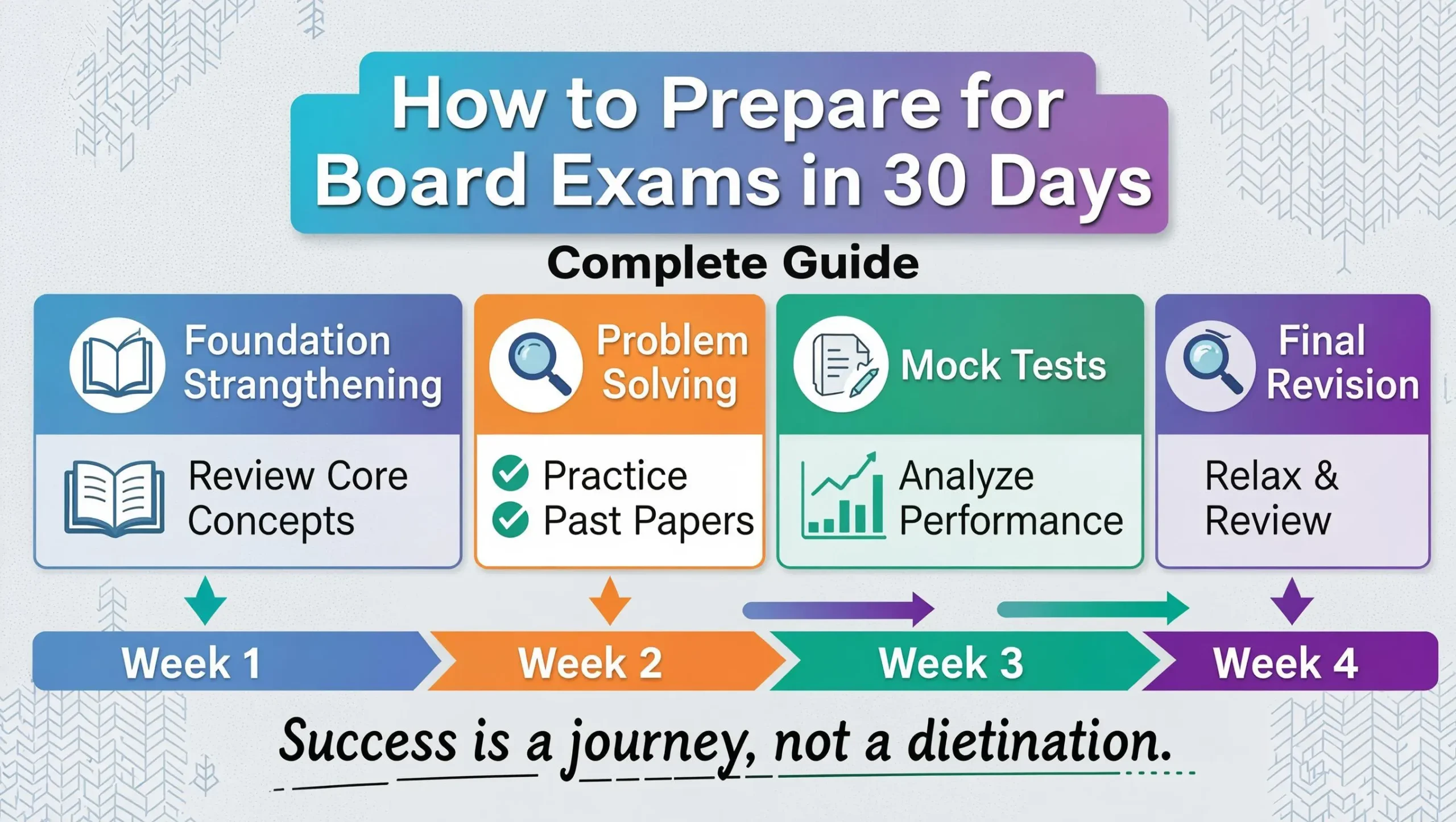
Week 1 (Days 1–7): Build Your Foundation
The first week is all about understanding where you stand and completing the most important parts of your syllabus. Don’t try to study every chapter in detail. Your goal is to cover the basics, identify weak areas, and prepare for revision in the coming weeks.
Many students make the mistake of spending three or four days on a single difficult chapter. This leaves very little time for other subjects. Instead, aim to cover every subject during the first week, even if you study each chapter briefly.
Your Goal for Week 1
By the end of Day 7, you should:
- Know which chapters are completed.
- Finish the most important topics in every subject.
- Prepare short notes for quick revision.
- Make a list of weak chapters that need extra practice.
Day 1: Check Your Preparation
Start by checking your current progress.
- Download or print the latest board syllabus.
- List all chapters for every subject.
- Mark each chapter as:
- Completed
- Needs Revision
- Not Started
- Highlight chapters that carry more marks.
Teacher’s Tip: Don’t feel disappointed if many chapters are still incomplete. Today is about making a clear plan, not judging your preparation.
Day 2: Complete Easy Chapters First
Choose chapters that you already understand.
Completing easy topics first will improve your confidence and help you score quick marks in the exam.
For example, if you already know Electricity in Science or Trigonometry in Mathematics, revise these chapters before starting difficult ones.
Day 3: Focus on Difficult Subjects
Now spend more time on subjects you usually find difficult.
If Mathematics takes longer than English, that’s completely normal.
Watch a short revision video if you don’t understand a concept, then solve textbook questions to check your understanding.
Don’t spend hours watching videos without practicing questions.
Day 4: Make Short Notes
Prepare one-page notes for every important chapter.
Include only:
- Important formulas
- Definitions
- Dates
- Diagrams
- Key points
- Important examples
These notes will save a lot of time during the final week before the exam.
Day 5: Solve Textbook Questions
Read the chapter once and then solve the exercise questions without looking at the answers.
If you get a question wrong, mark it with a star (★).
Revise these questions again during Week 3.
Day 6: Revise Everything You Studied
Don’t start new chapters today.
Instead, revise all the topics you studied during the last five days.
Many students skip revision because they feel they have less time. In reality, revision helps you remember what you’ve already learned.
Day 7: Check Your Progress
Take one sample paper or solve questions from different chapters.
After finishing, ask yourself:
- Which subject feels easiest now?
- Which chapter still needs more practice?
- Which mistakes did I repeat?
Write these answers in your notebook. They will help you plan Week 2 more effectively.
Week 1 Checklist
Before moving to Week 2, make sure you have completed these tasks:
- Reviewed the latest syllabus
- Studied every subject at least once
- Prepared short notes
- Revised completed chapters
- Solved textbook exercises
- Identified weak topics
Common Mistakes Students Make in Week 1
Avoid these mistakes:
- Reading one chapter for the whole day.
- Ignoring weak subjects.
- Making long notes instead of short revision notes.
- Watching too many YouTube videos without solving questions.
- Studying for long hours without taking short breaks.
Example
Suppose you have 15 chapters in Science.
Instead of trying to finish all 15 chapters in one week, you can:
- Complete 8 important chapters.
- Revise 4 chapters you already know.
- Keep the remaining 3 chapters for Week 2.
This approach helps you cover more marks without feeling overwhelmed.
Teacher’s Advice: Your goal during the first week is progress, not perfection. Even if you complete only 70–80% of your daily target, keep following your study plan. Small improvements every day lead to better results by exam time.
Week 2 (Days 8–14): Strengthen Your Concepts
By the beginning of Week 2, you should have covered the most important chapters and prepared short notes for revision. Now it’s time to improve your understanding of each subject through regular practice.
Reading alone is not enough. You need to solve questions, revise important topics, and identify the mistakes you make. This week is all about building confidence before you move on to mock tests.
Your Goal for Week 2
By the end of this week, you should:
- Complete the remaining important chapters.
- Solve textbook exercises regularly.
- Improve your weak subjects.
- Revise formulas, definitions, and important concepts every day.
- Practice previous year’s questions chapter by chapter.
Day 8: Start Solving Questions
Instead of reading the chapter again, begin solving questions.
Start with your NCERT or State Board textbook exercises. After completing them, solve a few questions from previous year’s board papers related to the same chapter.
For example, if you’re studying Quadratic Equations, solve textbook questions first and then attempt board exam questions from previous years.
Teacher’s Tip: If you cannot solve a question in 10–15 minutes, don’t spend the next hour on it. Check the solution, understand the method, and move on.
Day 9: Improve Your Weak Subject
Every student has one subject that feels more difficult than the others.
Today, spend extra time on that subject.
If Science is your weakest subject, revise one chapter carefully, make short notes, and solve at least 15–20 questions.
If Mathematics is difficult, practice problems step by step instead of simply reading the solutions.
Remember, weak subjects improve through practice, not by avoiding them.
Day 10: Practice Writing Answers
For theory subjects like English, Hindi, History, Political Science, or Biology, writing practice is just as important as reading.
Choose five important questions and write complete answers without looking at your notes.
After finishing, compare your answers with your textbook or teacher’s notes.
Check whether you:
- Included all important points.
- Used clear handwriting.
- Wrote the answer in the correct format.
- Managed your time properly.
Day 11: Revise Formulas and Important Facts
Today is for quick revision.
Spend 30–45 minutes revising:
- Mathematics formulas
- Science definitions
- Chemical equations
- Important dates
- Geography maps
- English grammar rules
Reading these every few days helps you remember them for a longer time.
Day 12: Solve Previous Year’s Questions
Choose one chapter from each subject and solve only previous year’s board questions.
While solving, notice:
- Which questions are repeated?
- Which topics carry more marks?
- Which mistakes do you make again and again?
Write these mistakes in a notebook.
This notebook will become one of your most useful revision tools during the final week.
Day 13: Mixed Subject Revision
Instead of studying only one subject today, revise three different subjects.
For example:
- Mathematics – 1 hour
- Science – 2 hours
- English – 1 hour
- Social Science – 2 hours
Changing subjects keeps your mind active and reduces boredom.
Day 14: Weekly Self-Test
Take a short test using questions from different subjects.
You don’t need a full three-hour paper.
Even a 60–90 minute self-test is enough to check your preparation.
After completing the test, ask yourself:
- Which questions were easy?
- Which topics took more time?
- Which mistakes can I avoid in the actual exam?
Best Study Methods for Week 2
Use these simple techniques every day:
Active Recall
Read a topic once.
Close the book.
Now explain the topic in your own words without looking at your notes.
If you forget important points, revise them again.
Formula Revision
Write important formulas on a separate sheet.
Read them every morning or before going to bed.
Short daily revision is more effective than reading everything only once a week.
Error Notebook
Keep one notebook only for mistakes.
Whenever you answer a question incorrectly, write:
- Chapter name
- Question
- Correct answer
- Reason for the mistake
Before every mock test, revise this notebook.
Many students improve their scores simply by avoiding repeated mistakes.
Common Mistakes During Week 2
Avoid these habits:
- Reading the same chapter repeatedly without solving questions.
- Ignoring previous year’s board papers.
- Spending the entire day on one difficult topic.
- Watching long YouTube lectures instead of practicing.
- Skipping daily revision because you feel busy.
Example
Suppose you solved 50 Mathematics questions today.
You answered 40 correctly and made mistakes in 10 questions.
Don’t feel disappointed.
Those 10 questions show exactly what you need to revise.
If you understand those mistakes today, you’re less likely to repeat them in the board exam.
Teacher’s Advice: Week 2 is the time to improve your understanding, not to chase perfect scores. Focus on learning from your mistakes. Every corrected mistake brings you one step closer to better marks.
Week 2 Checklist
Before moving to Week 3, make sure you have:
- Solved textbook exercises
- Practiced previous year’s questions
- Revised formulas and important definitions
- Improved at least one weak subject
- Created an error notebook
- Completed a weekly self-test
Week 3 (Days 15–21): Mock Tests and Revision
By the time you reach Week 3, you should have completed most of your syllabus and revised the important chapters. Now it’s time to check how well you can apply what you’ve learned.
This week is not about studying new topics. Instead, your main focus should be solving mock tests, practicing previous year’s board papers, and improving the mistakes you make. Every mock test will help you understand your strengths and the areas that still need more attention.
Your Goal for Week 3
By the end of this week, you should:
- Solve at least 4–5 full-length practice papers.
- Improve your speed and accuracy.
- Learn how to manage time during the exam.
- Reduce repeated mistakes.
- Feel more confident before the final revision week.
Day 15: Take Your First Full Mock Test
Choose one previous year’s board paper or a sample paper.
Follow the same rules as the actual board exam.
- Sit at a clean desk.
- Keep only the allowed stationery with you.
- Set a timer according to the exam duration.
- Don’t check your phone or books while writing.
Treat this paper like the real exam.
Don’t worry if your score is lower than expected. The purpose of the first mock test is to understand where you need to improve.
Day 16: Review Your Mistakes
Today, don’t take another test.
Instead, spend time checking yesterday’s paper.
Ask yourself:
- Which questions did I answer incorrectly?
- Did I forget important concepts?
- Did I make calculation mistakes?
- Did I lose marks because I didn’t read the question carefully?
- Did I run out of time?
Write these mistakes in your error notebook.
This notebook will become one of your most valuable revision tools.
Day 17: Practice Weak Topics
Use yesterday’s analysis to improve.
For example:
If you lost marks in Algebra, solve 20 more Algebra questions.
If you forgot important Biology diagrams, practice drawing them again.
Don’t revise everything today.
Focus only on the topics where you made mistakes.
Day 18: Second Mock Test
Take another full-length practice paper.
Try to improve the mistakes you made in your first test.
After finishing, compare your performance.
Ask yourself:
- Did I finish the paper on time?
- Did I make fewer careless mistakes?
- Is my handwriting clear?
- Did I answer every question?
Even a small improvement means your preparation is moving in the right direction.
Day 19: Quick Revision Day
Today is for revision, not another full test.
Spend time revising:
- Short notes
- Formula sheets
- Important definitions
- Maps
- Diagrams
- Frequently asked questions
Also revise the mistakes written in your error notebook.
Many students forget this step, but it helps prevent repeating the same errors.
Day 20: Third Mock Test
Attempt another sample paper.
This time, pay special attention to:
- Time management
- Question selection
- Presentation of answers
- Neat handwriting
- Underlining important keywords where appropriate
Imagine that an examiner is checking your answer sheet.
Clear presentation can leave a good impression and make your answers easier to read.
Day 21: Weekly Performance Review
This is the final day of Week 3.
Instead of studying for long hours, review your progress.
Ask yourself these questions:
- Which subject has improved the most?
- Which chapters still need revision?
- What mistakes am I repeating?
- Which subject needs more attention next week?
Use your answers to plan your final revision.
How to Review a Mock Test
Don’t look only at your score.
Check these points as well:
| Review Point | Questions to Ask |
|---|---|
| Time Management | Did I finish the paper on time? |
| Accuracy | How many careless mistakes did I make? |
| Concepts | Which chapters need more revision? |
| Presentation | Was my handwriting neat and easy to read? |
| Confidence | Which questions made me nervous? |
A good review helps you improve much faster than simply solving another paper.
Smart Tips for Mock Tests
- Attempt the paper in one sitting.
- Don’t pause the timer.
- Read every question carefully before answering.
- Leave difficult questions for later.
- Keep the last 10–15 minutes for checking your answers.
- Review your mistakes after every test.
Common Mistakes During Week 3
Avoid these mistakes:
- Solving mock tests without checking the answers later.
- Feeling discouraged after one low score.
- Ignoring careless mistakes.
- Practicing only your favorite subjects.
- Taking too many mock tests without revision.
Remember, one well-reviewed mock test is more useful than three papers that you never analyze.
Example
Suppose your first mock test score is 62 out of 100.
Instead of feeling disappointed, check where you lost marks.
You may find that:
- 12 marks were lost because of calculation mistakes.
- 10 marks were lost because you skipped two questions.
- 8 marks were lost because you forgot formulas.
Now you know exactly what to improve before the next test.
This approach helps many students increase their scores within a week.
Teacher’s Advice: Don’t judge your preparation by one mock test. Every practice paper teaches you something new. Learn from your mistakes, make small improvements every day, and you’ll walk into the exam hall with much more confidence.
Week 3 Checklist
Before moving to the final week, make sure you have:
- Solved at least 4–5 mock tests.
- Reviewed every paper carefully.
- Updated your error notebook.
- Improved your time management.
- Revised weak chapters.
- Practiced answer presentation.
Week 4 (Days 22–30): Final Revision Strategy
Congratulations! You’ve reached the final stage of your preparation. By now, you should have completed the important chapters, solved practice papers, and identified your weak areas.
The last nine days are not meant for learning new chapters. Instead, use this time to revise what you already know, improve your confidence, and avoid repeating mistakes in the exam.
Many students feel nervous during the final week and start studying random topics. This usually creates confusion and increases stress. Stick to your revision plan and trust the hard work you’ve already done.
Your Goal for Week 4
By the end of Day 30, you should:
- Revise all important chapters.
- Remember key formulas, definitions, and diagrams.
- Build confidence for the exam.
- Improve answer presentation.
- Stay physically and mentally healthy.
Day 22: Revise Your Short Notes
Start your final revision with the short notes you prepared during Week 1.
Focus on:
- Important formulas
- Definitions
- Key concepts
- Important dates
- Diagrams
- Maps
Avoid reading the complete textbook again unless you have difficulty understanding a topic.
Teacher’s Tip: Your short notes are your best revision tool now. They help you revise more topics in less time.
Day 23: Revise Your Weak Subjects
Today, spend extra time on the subjects that still feel difficult.
For example:
- If Mathematics is your weak subject, solve important problems from high-weightage chapters.
- If Biology is difficult, revise diagrams and scientific terms.
- If History is challenging, prepare short timelines for important events.
Don’t compare your weak subjects with someone else’s strengths. Focus only on improving your own preparation.
Day 24: Practice One Full Sample Paper
Choose a sample paper and solve it in exam conditions.
After completing it:
- Check your answers carefully.
- Look for repeated mistakes.
- Notice if you finished on time.
- Improve your handwriting and answer presentation.
The goal isn’t to get a perfect score. The goal is to become more comfortable with the exam pattern.
Day 25: Revise Your Error Notebook
Open the notebook where you recorded mistakes from previous tests.
Read every mistake carefully.
Ask yourself:
- Why did I make this mistake?
- Do I understand the correct answer now?
- Am I likely to repeat this mistake?
Learning from your own mistakes is one of the fastest ways to improve your marks.
Day 26: Quick Revision of All Subjects
Instead of studying one subject for the whole day, revise all your subjects briefly.
A sample plan:
- Mathematics – Formulas
- Science – Definitions and diagrams
- English – Grammar and writing formats
- Social Science – Important dates and maps
- Language Subject – Literature summaries
This keeps every subject fresh in your mind.
Day 27: Improve Answer Presentation
Good presentation makes your answer sheet easier to read.
Practice:
- Writing clear headings.
- Keeping proper spacing.
- Underlining important keywords where appropriate.
- Drawing neat diagrams with labels.
- Numbering answers correctly.
These habits won’t replace good knowledge, but they can help present your answers more clearly.
Day 28: Light Revision Only
Don’t study for long hours today.
Spend your time revising:
- Formula sheets
- Flashcards
- Important definitions
- Frequently asked questions
Take regular breaks and avoid unnecessary stress.
Sometimes a calm and focused mind performs better than studying late into the night.
Day 29: Get Ready for Exam Day
Today is about preparation, not pressure.
Check that you have:
- Admit Card
- School ID (if required)
- Pens and pencils
- Geometry box (if needed)
- Transparent water bottle (if allowed)
- Watch (if permitted by your board)
Also confirm:
- Exam centre location
- Reporting time
- Subject and exam date
Packing everything one day earlier helps you avoid last-minute panic.
Day 30: Stay Calm and Believe in Yourself
This is the final day before your exam.
Don’t start a new chapter today.
Instead:
- Revise your short notes.
- Read important formulas.
- Go through key diagrams.
- Spend a little time relaxing.
- Sleep early so you feel fresh the next morning.
Remember, your preparation is already complete. Today is only for refreshing your memory and staying confident.
Last 24 Hours Before the Exam
Here’s what you should do:
- Revise short notes.
- Read formulas and important definitions.
- Drink enough water.
- Eat light and healthy food.
- Sleep for at least 7–8 hours.
- Reach the exam centre early.
Things to Avoid During the Final Week
Many students make these mistakes just before the exam.
Avoid them:
- Starting new chapters.
- Studying throughout the night.
- Comparing your preparation with friends.
- Watching too many last-minute revision videos.
- Ignoring meals or sleep.
- Feeling nervous because someone else has studied more.
Example
Imagine two students.
Student A starts three new chapters the day before the exam and stays awake until 2:00 AM.
Student B revises short notes, checks important formulas, packs the exam materials, and sleeps on time.
The next morning, Student B is more relaxed and better prepared to answer questions because they revised what they already knew instead of trying to learn everything at the last minute.
Teacher’s Advice: The final week is not about studying harder—it’s about studying smarter. Trust your preparation, revise regularly, and stay calm. A confident mind often performs better than an exhausted one.
Week 4 Checklist
Before your exam, make sure you have:
Revised all important chapters.
- Reviewed your short notes.
- Practiced at least one final sample paper.
- Revised your error notebook.
- Packed all required exam materials.
- Slept well before the exam.
Daily Study Timetable (6–8 Hours)
A good study timetable helps you stay organized and complete your daily goals without feeling stressed. However, remember that there is no perfect timetable that works for everyone.
Some students prefer studying early in the morning, while others concentrate better in the evening. Choose a routine that matches your daily schedule and follow it consistently.
The most important thing is not the number of hours you study, but how well you use those hours.
Sample Study Timetable (6–8 Hours)
| Time | Activity |
|---|---|
| 6:30 AM – 7:00 AM | Wake up, freshen up, and do light exercise or stretching |
| 7:00 AM – 9:00 AM | Study Session 1 (Difficult Subject) |
| 9:00 AM – 9:30 AM | Breakfast and short break |
| 9:30 AM – 11:30 AM | Study Session 2 (Problem-solving or Numerical Practice) |
| 11:30 AM – 12:00 PM | Revision of formulas or important notes |
| 12:00 PM – 2:00 PM | Lunch and rest |
| 2:00 PM – 4:00 PM | Study Session 3 (Theory Subject) |
| 4:00 PM – 5:00 PM | Break, walk, or light physical activity |
| 5:00 PM – 7:00 PM | Revision and Practice Questions |
| 7:00 PM onwards | Dinner, family time, and light revision before sleeping |
How to Divide Your Study Sessions
Instead of studying one subject all day, divide your time between different subjects.
Morning Session
Study the subject you find most difficult.
For example:
- Mathematics
- Physics
- Accountancy
Your mind is usually fresher in the morning, making it easier to solve difficult problems.
Afternoon Session
Choose a theory subject like:
- Biology
- History
- Political Science
- Business Studies
Read the chapter, make short notes, and revise important points.
Evening Session
Use this time for revision.
You can:
- Solve previous year’s questions.
- Revise formulas.
- Practice diagrams.
- Review mistakes from your notebook.
Ending the day with revision helps you remember important topics for longer.
Take Short Breaks
Studying continuously for several hours can reduce your concentration.
A simple routine is:
- Study for 50–60 minutes.
- Take a 10-minute break.
- Drink water, stretch, or walk around.
- Avoid using your phone during short breaks because it’s easy to lose track of time.
Short breaks help you return to your books with better focus.
Flexible Timetable for Different Students
If You Attend School
- Study for 2–3 hours after school.
- Revise for 1–2 hours in the evening.
- Spend extra time on weekends solving sample papers.
If You Attend Coaching Classes
Plan your self-study around your coaching schedule.
For example:
- Revise today’s coaching topics the same evening.
- Solve additional practice questions before the next class.
- Keep one day each week for revision and mock tests.
If You’re Studying at Home
You have more flexibility, but it’s also easier to get distracted.
Create fixed study hours and follow them every day.
Treat your study time like school hours. Avoid checking your phone or social media until you’ve completed your daily target.
How Many Hours Should You Study?
The answer depends on your preparation.
- If your syllabus is almost complete, 5–6 hours of focused study with regular revision may be enough.
- If you still have many chapters left, aim for 7–8 hours by dividing your time into manageable study sessions.
Don’t compare your study hours with your friends. Some students learn faster, while others need more revision. Focus on completing your daily goals instead of counting hours.
Example Study Plan
Suppose today’s subjects are:
Mathematics
- Revise Algebra formulas.
- Solve 20 practice questions.
Science
- Read one chapter.
- Draw important diagrams.
- Solve textbook exercises.
English
- Practice one writing task.
- Revise grammar rules.
By setting clear goals, you’ll know exactly what you need to complete instead of sitting with books without a plan.
Common Timetable Mistakes
Avoid these habits:
- Studying one subject for the whole day.
- Skipping breaks.
- Staying awake late every night.
- Using your phone during study time.
- Making a timetable that’s impossible to follow.
- Ignoring revision.
Daily Study Checklist
Before ending your day, ask yourself:
- Did I complete today’s study target?
- Did I revise yesterday’s topics?
- Did I solve practice questions?
- Did I review my mistakes?
- Did I prepare tomorrow’s study plan?
Even if you miss one target, don’t feel discouraged. Simply adjust your schedule and continue the next day.
Teacher’s Advice: A simple timetable that you follow every day is far better than a perfect timetable that you abandon after a few days. Stay consistent, revise regularly, and focus on improving a little every day.
Subject-wise Preparation Tips
Every subject requires a different study method. For example, Mathematics needs regular practice, while History requires good understanding and revision. Instead of using the same study technique for every subject, follow the preparation tips below to improve your performance in each subject.
Mathematics
Mathematics is one of the highest-scoring subjects if you practice regularly. Reading formulas is not enough—you need to solve questions every day.
Start with the chapters that carry more marks in your board exam. Once you understand the concept, solve textbook exercises before moving to sample papers or previous year’s questions.
How to Prepare
- Revise formulas every morning.
- Practice at least 20–30 questions daily.
- Solve previous year’s board questions.
- Write every calculation step clearly.
- Revise incorrect questions again after two or three days.
Common Mistakes to Avoid
- Memorizing formulas without solving questions.
- Skipping difficult chapters.
- Ignoring calculation mistakes.
- Not checking answers after completing the paper.
Teacher’s Tip: If you make a mistake while solving a question, don’t erase it immediately. First, understand where you went wrong. This helps you avoid the same mistake in the exam.
Science (Physics, Chemistry, and Biology)
Science combines theory, practical understanding, and problem-solving. Give equal importance to all three subjects instead of focusing only on your favorite one.
Physics
Physics becomes easier when you understand the concepts before solving numerical questions.
Focus On
- Important formulas
- Numerical problems
- Diagrams
- Units and measurements
- Previous year’s numerical questions
Example: If you’re studying Electricity, first understand the formulas, then solve numerical questions instead of memorizing answers.
Chemistry
Chemistry requires regular revision because students often forget reactions and equations.
Revise Every Day
- Chemical equations
- Periodic table trends
- Important formulas
- Named reactions
- Definitions
Create a one-page revision sheet for each chapter.
Biology
Biology is easier to remember when you use diagrams and flowcharts.
Practice
- Label diagrams neatly.
- Learn scientific terms carefully.
- Revise definitions.
- Practice short and long-answer questions.
Drawing important diagrams two or three times before the exam helps you remember them more easily.
English
Many students spend very little time on English, but it can improve your overall percentage.
Don’t study English only one day before the exam.
Practice Daily
- Reading comprehension
- Grammar
- Letter writing
- Article writing
- Notice writing
- Essay writing
Read your textbook chapters carefully and revise important character names, themes, and summaries.
Common Mistakes
- Ignoring grammar practice.
- Not following the correct writing format.
- Writing very long answers without answering the question properly.
Teacher’s Tip: Spend 20–30 minutes every day reading English. This improves your vocabulary and writing skills naturally.
Hindi or Other Language Subjects
Language subjects also require regular practice.
Focus on:
- Grammar
- Writing formats
- Important poems
- Chapter summaries
- Vocabulary
Read the textbook instead of depending only on guidebooks.
Try writing answers in your own words whenever possible.
Social Science
Many students think Social Science is only about memorizing answers.
Actually, understanding the topic first makes revision much easier.
History
Instead of memorizing every paragraph, understand:
- What happened?
- Why did it happen?
- What was the result?
This helps you write better answers during the exam.
Geography
Practice maps regularly.
Also revise:
- Resources
- Climate
- Agriculture
- Industries
Map questions often carry easy marks if you practice regularly.
Political Science
Focus on:
- Important definitions
- Government systems
- Constitutional features
- Rights and duties
- Important examples
Read each chapter carefully before memorizing points.
Economics
Understand the concepts instead of learning definitions without meaning.
Topics such as demand, supply, poverty, employment, and development become easier when you relate them to real-life examples.
Commerce Students (If Applicable)
If you’re preparing for Commerce subjects, follow these tips.
Accountancy
- Practice journal entries daily.
- Solve numerical questions regularly.
- Learn accounting formats.
- Check calculations carefully.
Business Studies
- Understand concepts before memorizing.
- Prepare one-page notes.
- Practice case-study questions.
Economics
- Revise graphs and important definitions.
- Solve numerical questions if included in your syllabus.
- Practice writing answers using correct economic terms.
Computer Science / Information Technology (If Applicable)
For Computer Science:
- Revise programming concepts.
- Practice writing code on paper.
- Learn important syntax.
- Revise database concepts.
- Solve previous year’s practical questions.
Understanding the logic behind the program is more useful than memorizing code.
Subject-wise Revision Plan
| Subject | Daily Practice Time | Main Focus |
|---|---|---|
| Mathematics | 1–2 Hours | Formulas and problem-solving |
| Science | 1.5–2 Hours | Concepts, diagrams, and numerical questions |
| English | 30–45 Minutes | Grammar and writing practice |
| Hindi / Language | 30–45 Minutes | Grammar and literature |
| Social Science | 1 Hour | Maps, important events, and revision |
| Commerce (Optional) | 1–2 Hours | Numerical practice and concepts |
General Tips for Every Subject
No matter which subject you’re studying:
- Read the chapter carefully.
- Make short notes.
- Revise regularly.
- Solve textbook exercises.
- Practice previous year’s board questions.
- Review your mistakes after every test.
Small daily improvements can make a noticeable difference by the time your board exams begin.
Teacher’s Advice: Don’t give equal time to every subject. Spend more time on the subjects where you need improvement while continuing to revise the subjects you’re already confident in. A balanced study plan helps you improve your overall score.