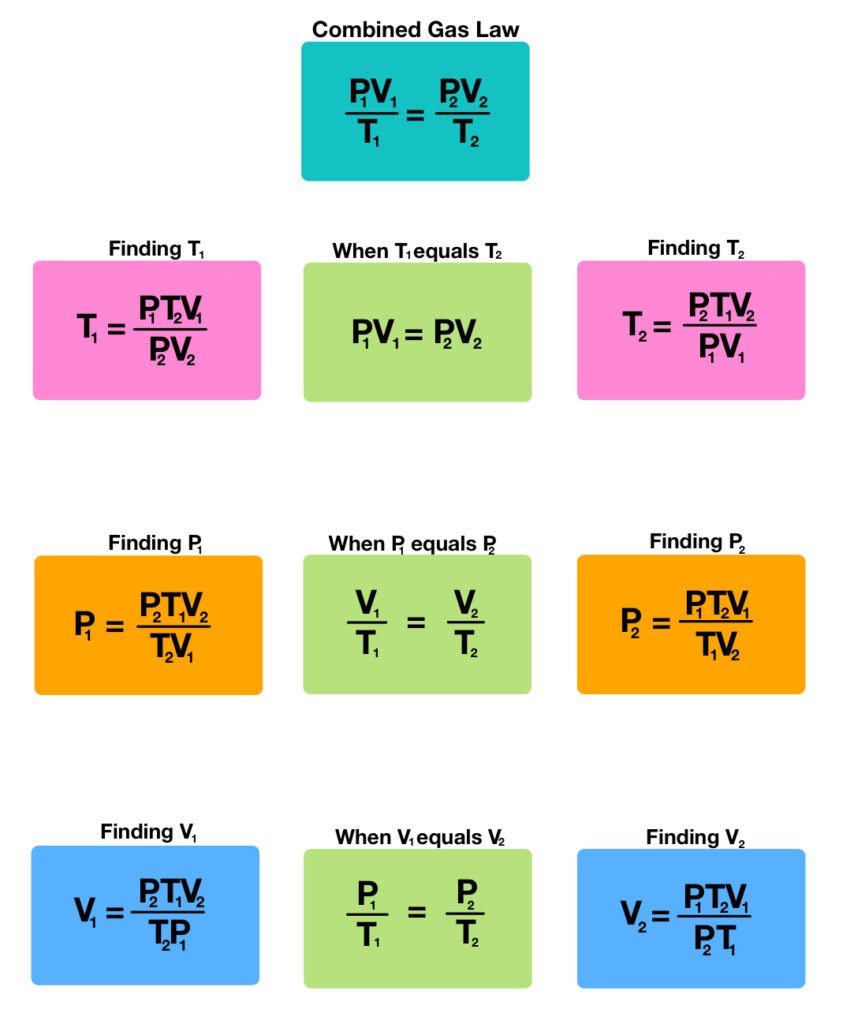
Combined gas law can be mathematically expressed as
k = PV/T
Where,
P = pressure
T = temperature in kelvin
V = volume
K = constant (units of energy divided by temperature)
When two substances are compared in two different conditions, the law can be stated as,
PiVi/Ti = PfVf/Tf
Where,
Pi = initial pressure
Vi = initial volume
Ti = initial temperature
Pf = final pressure
Vf= final volume
Tf = final temperature
Combined Gas Law Formula and Definition
The combined gas law is a fundamental concept in chemistry that relates the volume, temperature, and pressure of gases. It provides a way to describe and predict the behavior of gases under
various conditions.
Formula:
The combined gas law formula is:
P₁V₁ / T₁ = P₂V₂ / T₂
Explanation:
- The combined gas law states that the product of pressure (P) and volume (V) of a gas is equal to a constant, regardless of temperature (T).
- This law helps us understand how changes in pressure, volume, or temperature affect the behavior of gases.
Applications:
- Gas mixtures
- Compressibility of gases
- Gas diffusion
Significance:
The combined gas law has numerous applications in chemistry, physics, and engineering. It’s used to describe phenomena such as:
- Gas-liquid equilibria
- Adsorption and desorption processes
- Gas transport and storage