
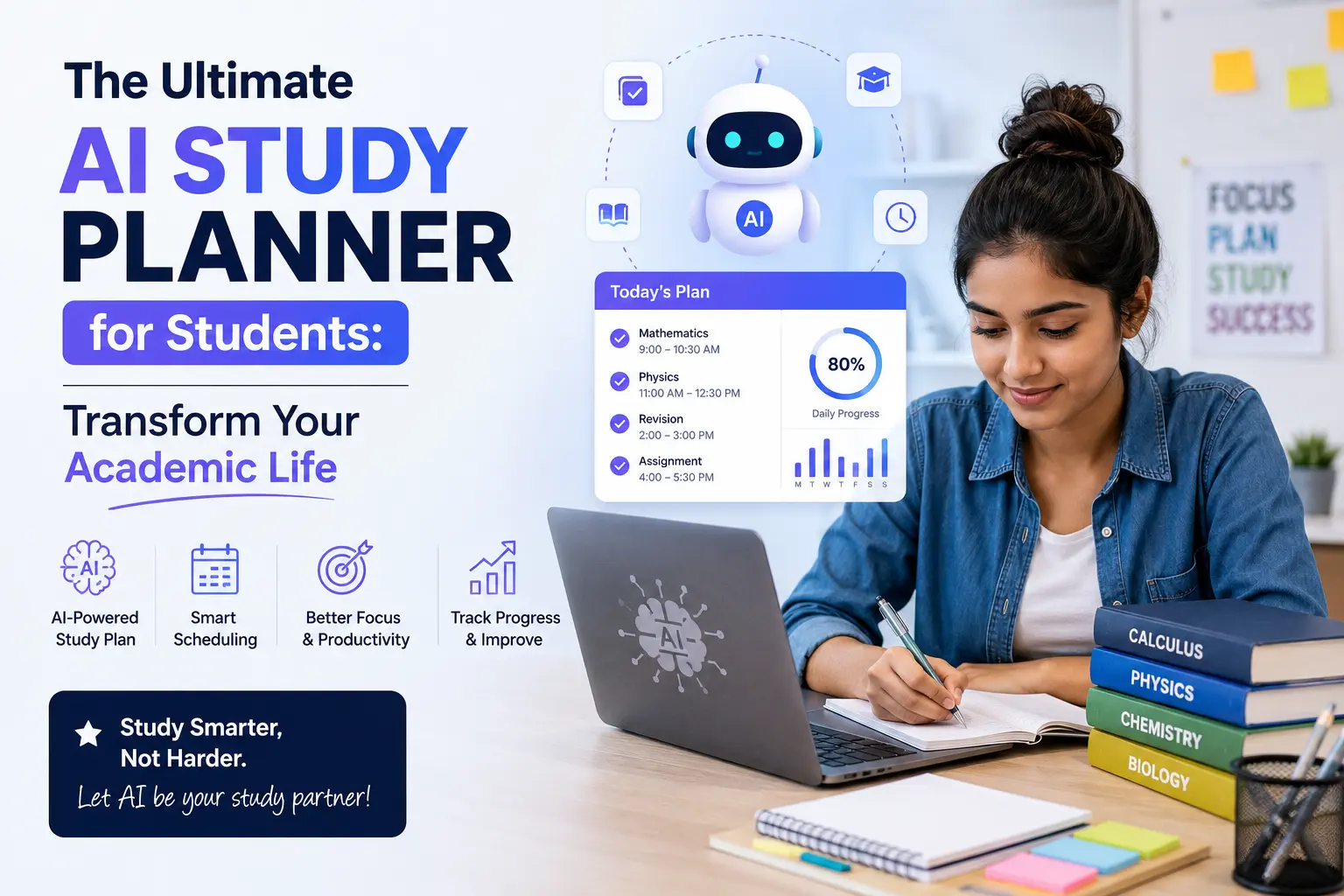
Being a student right now is exhausting. Between back-to-back lectures, endless assignments, exam prep, and trying to salvage some kind of social life, just keeping your head above water is a struggle. For years, the standard fix has been a classic paper planner or a basic calendar app. But let’s be real—scribbling “Study Bio” in a Tuesday 4:00 PM slot rarely translates to actual, focused learning. More often than not, it just sits there, guilt-tripping you from across the room.
Enter the AI study planner.
Forget the usual tech hype. This isn’t just another passing trend; it’s a massive shift in how we actually learn. Instead of trying to force yourself into a rigid, unrealistic study schedule, AI is helping students build flexible routines that actually adapt to real life.
If you’ve ever sat at your desk staring blankly at an open textbook, feeling completely overwhelmed, you’re not alone. Here is how an AI study planner can help you take control of your workload—and finally make studying feel a whole lot easier.
What Exactly is an AI Study Planner?
Think of an AI study assistant as a personal coach rather than just another app. While a standard digital calendar does little more than hold your to-do list, a smart planner actually works with you. It maps out your study sessions, learns your habits, and constantly adapts on the fly to help you get the most out of your time.
Just toss in your syllabus, work shifts, and upcoming deadlines, and the tool goes to work crafting a custom study plan tailored to your life. But it goes deeper than just filling in calendar blocks. It actually structures your day around how your brain works, factoring in things we easily overlook—like mental fatigue, memory retention science, and your natural daily energy slumps. It’s basically like having a personal academic advisor on call 24/7, right in your pocket.
Why Every Student Needs an AI-Powered Schedule
Making the leap from high school to university is a brutal wake-up call. You go from highly structured, bell-to-bell days to massive stretches of completely empty time. It sounds amazing at first, but without a plan, it’s the perfect recipe for procrastination and panic.
If you’re already struggling to keep your head above water, an AI study planner might just be your saving grace. Here is why it’s a total game-changer for beating the college stress:
Hyper-Personalization
Let’s face it—no two study schedules look the same. You might be the type to crush calculus over morning coffee at 7 AM, or maybe you’re a night owl memorizing history terms long after midnight.
A solid AI study planner gets this. Instead of forcing you into a rigid routine, it actually learns how you tick. If you keep hitting snooze on those brutal 8 AM study alarms, the app catches on. It’ll automatically slide those brain-heavy tasks to a time of day when you’re actually awake and ready to focus.
Dynamic Rescheduling
Let’s be honest—life rarely goes according to plan. You get sick, a professor suddenly bumps up a deadline, or a family emergency pops up out of nowhere. If you’re using a traditional paper planner, just one missed day can derail your entire week, triggering a massive wave of anxiety.
An AI homework planner, on the other hand, is built to roll with the punches. If you miss a two-hour chemistry study block on Wednesday, you don’t have to panic. The system instantly reshuffles your schedule, tucking those lost hours into your remaining free slots so you stay on track without the stress.
Beating Procrastination with Micro-Tasks
Staring down a massive task like “Write a 10-page research paper” is a one-way ticket to procrastination. Before you know it, you’re deep-cleaning your kitchen just to avoid starting.
A smart study planner fixes this by chopping giant, overwhelming projects into tiny, realistic steps. Instead of demanding a finished paper, it schedules quick, low-stress tasks: “Find three sources,” “Draft a rough thesis,” or “Write the intro.” When you make starting this easy, the urge to procrastinate just fades away.
Scientifically Backed Exam Prep with AI
Cramming the night before an exam is a rite of passage, but it’s scientifically proven to be the worst way to retain information. The best AI study planners use cognitive science concepts such as spaced repetition and active recall to help you study for exams with AI. If you have a midterm in 6 weeks, the system will automatically schedule short, intermittent review sessions for old material, moving that information from your short-term memory to your long-term memory.
How to Choose the Best AI Study Planner
When there are so many educational tech tools available, how do you choose the best AI study planner for you? Look for these key features:
Syllabus Importing: Upload a PDF of your syllabus and let the AI automatically extract every reading assignment, quiz and project deadline.
Flexibility Inputs: You should be able to tell the AI exactly when you cannot study (e.g. “Do not schedule anything between 5PM and 7PM due to soccer practice”).
Integration Capabilities: It should integrate seamlessly into your existing ecosystem, such as Google Calendar, Apple Calendar or learning management systems like Canvas and Blackboard.
Task Prioritization: The AI should let you mark high priority items so it spends more time and your peak focus hours on your hardest subjects.
How to Integrate an AI Study Planner Into Your Routine
“Having the right tool is only half the battle, it is knowing how to use it that drives results. Here’s a simple framework to make the most out of the AI study planner for students:
Be Brutally Honest with Your Data:
An AI is only as good as the data you feed it. Don’t tell the app that you can study for five hours on a Saturday if you know you usually spend that time socializing or resting. Enter your real sleep schedule, commute times, and breaks.
Review, Don’t Just Obey:
Treat your personalized study plan like a living document. At the end of each week, spend ten minutes reviewing what the AI scheduled vs. what you actually accomplished. Revert the system. Change default session times if a block was too long.
Protect Your Mental Health:
No AI learning assistant, however advanced, can replace the human need for rest. Make sure the tool you choose has enough down time. A well rested brain learns at an exponential rate compared to a sleep deprived brain. Leverage the AI to schedule social and self-care activities as strictly as you do your academic ones.
The Future of Student Success
We are in a time where the technology can finally fit us, instead of us fitting the technology. No more guilt for leaving an abandoned, messy paper planner. Using a smart study planner, you are removing the guesswork from academia. You’re trading anxiety for structure, and chaos for clarity.
No matter where you are in your academic journey—whether you’re a freshman adapting to college life or a graduate student managing research and deadlines—an AI-powered study planner can transform the way you learn. Instead of spending valuable time organizing your study schedule, tracking assignments, and planning revision sessions, let artificial intelligence create an efficient study plan for you. With the logistics taken care of, you can focus on what truly matters: learning effectively, improving your understanding, and reaching your academic goals with greater confidence.