
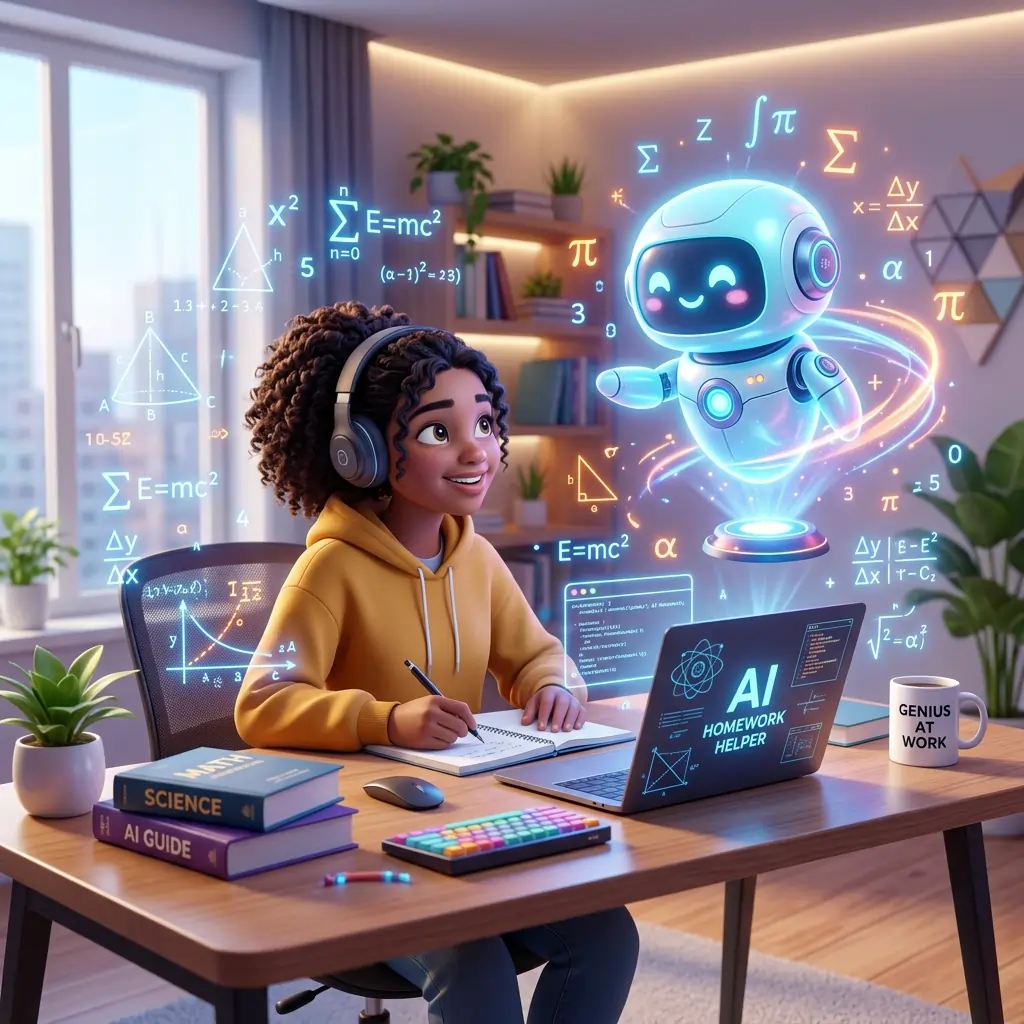
It’s 11:30 PM. You’re locked in a staring contest with a blank screen, hopelessly stuck on a brutal calculus equation—or trying to figure out how on earth you’re going to spin a history essay into 2,000 words. The panic is real, and the clock is ticking.A few years ago, your options were pretty grim: pull a miserable all-nighter, take a wild guess, or pray your teacher checked their email before morning. Today, though, a lifeline is just a tab away: the AI homework helper.Not long ago, AI felt like something straight out of a sci-fi movie. Today, it’s just another tool students use to get through their weekly assignments.But what actually qualifies as an “AI homework helper”? How does it work under the hood? And—most importantly—how do you use it to study without crossing the line into cheating?
Here’s a practical breakdown of how to make these tools work for you, boost your grades, and stay completely out of trouble.
How Does an AI Homework Helper Actually Work?
To put it simply, these tools are built on Large Language Models (LLMs)—the same technology powering household names like GPT-4, Claude, and Gemini. Before these AI assistants ever helped their first student, they “read” through mountains of information, digesting millions of books, academic papers, websites, and textbooks to learn how language and logic work.
But what happens when you type in a question like “How do I solve for x?” or “Can you explain the Pythagorean theorem?”
It’s easy to feel like you’re talking to a genius, but the AI isn’t actually “thinking” the way we do. Instead, it uses Natural Language Processing (NLP) to translate and make sense of your question. Once it understands what you’re asking, it plays a highly sophisticated game of prediction. By looking at the patterns in its massive database, it calculates the most logical, accurate sequence of words and numbers to build your answer. Think of it like autocomplete, but incredibly smart.
Today’s homework helpers go way beyond simple text, too. Many of them now have “eyes.” Thanks to computer vision, you can just snap a quick picture of a messy algebra equation or a confusing chemistry diagram. The AI reads the image, breaks down the problem, and walks you through the solution step-by-step.
Why AI is Actually a Lifesaver for Homework (If You Use It Right)
Let’s face it: school is stressful, and everyone gets stuck sometimes. While some people immediately write off AI as a tool for cheating, using it as a personal study buddy can completely change the way you learn.
If you use it the right way, an AI assistant is one of the best academic tools you can have in your corner. Here is why.
1. It’s Awake at 3 AM (And It’s Free)
Private tutors are incredibly expensive, and they definitely don’t work graveyard shifts. If you are spiraling over a chemistry problem at midnight on a Sunday, you can’t exactly call your teacher for help.
An AI tool, however, is always online. Instead of getting frustrated, closing your laptop, and losing your momentum, you can get unstuck immediately and actually finish your assignment on time.
2. It Explains Things Until You Actually Get It
Teachers have a tough job. They have to pace their lessons for thirty different students at once, which means some kids get left behind while others get bored. AI adapts entirely to you.
If a concept feels like gibberish, you don’t have to feel embarrassed about asking for clarification. You can literally type, “Explain this to me like I’m ten years old,” or “Give me a baseball analogy for this physics concept.” The AI won’t lose patience; it will keep rephrasing the explanation in a dozen different ways until it finally clicks.
3. It Shows the Work (Because the Answer is Only Half the Battle)
In math and science, simply writing down the final answer is a quick way to get zero credit. Teachers want to see your process.
A good AI homework tool doesn’t just hand you “x = 5” and call it a day. It acts like a digital whiteboard, breaking down the equation step-by-step. By showing you how to get from point A to point B, it teaches you the logic behind the formula so you can actually solve it on your own during the exam.
4. It Cures the “Blank Page” Panic
There is nothing more intimidating than staring at a blinking cursor on an empty Google Doc. When it comes to writing essays or research papers, just getting started is usually the hardest part.
You can use AI as a collaborative partner to kickstart your brain. Ask it to help you brainstorm essay topics, organize your messy thoughts into a clean outline, or suggest a strong thesis statement. Once you have a solid foundation, writing the actual paper becomes infinitely easier.
The Catch: What They Don’t Tell You About AI Homework Helpers
Sure, AI is incredibly powerful. But leaning too hard on it is a massive gamble, and you need to know exactly what you’re risking before you hit “generate.”
1. It Straight-Up Makes Things Up (With Supreme Confidence)
AI doesn’t actually “know” anything; it’s essentially a super-advanced guessing machine. Because of this, it frequently “hallucinates”—a polite tech term for lying with a straight face. If you ask it to write a history essay, it might hand you a beautifully written paper complete with fake quotes, fabricated dates, and historical figures who never existed. If you don’t double-check every single line, you’re going to get caught.
2. The Academic Integrity Minefield
Let’s be real: copy-pasting an AI-generated essay or stealing code for your CS homework is academic suicide. Schools have caught on, and they aren’t playing around. Getting flagged for using ChatGPT can easily lead to a zero on the assignment, failing the course, or in worst-case scenarios, getting suspended or expelled. It’s simply not worth the risk.
3. It Turns Your Brain to Mush
School isn’t just a game of turning in answers to get a grade; it’s mental weightlifting. When you let an AI do all the heavy lifting, your brain goes soft. You’re basically outsourcing your critical thinking to a program. That might feel great on a Tuesday night when you’re tired, but when midterms roll around and you’re sitting in a quiet exam hall with just a pencil and your own thoughts, you’ll realize you have no idea how to actually solve the problems.
How to Use an AI Study Buddy Without Cheating (The Ethical Way)
To get the most out of AI without crossing the line into plagiarism, you need a quick mental shift. Stop looking at ChatGPT or Claude as a cheat code to get easy answers. Instead, treat it like a 24/7 personal tutor.
Here is how to use it the right way:
- Ask “how,” not “what.” If you’re stuck on math homework, don’t just type in, “What’s the answer to question 5?” That’s a fast track to learning absolutely nothing. Instead, try asking, “Can you walk me through the steps to solve this kind of physics problem?” or “What formula should I use here?” You want the roadmap, not just the destination.
- Let it be your editor, not your ghostwriter. Write your essay yourself first. Seriously—get your own thoughts down on paper. Once you have a rough draft, feed it to the AI and ask for feedback. Try something like: “Hey, can you check this draft for typos and let me know if my thesis statement makes sense?” This keeps your voice authentic while polishing the rough edges.
- Double-check everything. AI is notorious for making things up with absolute confidence (a phenomenon known as hallucination). Never take its word as gospel. If it throws a date, quote, or statistic at you, spend two minutes double-checking it in your textbook or a trusted database. If you cite a fake source on a paper, “the AI told me so” won’t save your grade.
- Know your teacher’s rules. Every school—and every individual teacher—has different boundaries. One teacher might love it if you use AI to brainstorm essay ideas, while another might consider it an automatic fail. If the syllabus isn’t clear, just ask. It’s always better to get the green light beforehand than to try explaining yourself in a disciplinary meeting later.
Where Is This All Heading?
AI in schools isn’t some temporary fad. it is completely rewriting the rules of how we learn. Down the road, these tools will probably be built right into our school curriculums. Instead of students sneaking around to use them, AI will likely act as official, personalized study guides tailored to how individual students learn.
But until that becomes the norm, the ball is in your court. You have to be the one to use these tools responsibly. Think of AI as a high-powered sports car: it can get you where you need to go incredibly fast, but you still have to be the one steering. If you use it to sharpen your own brain rather than do the thinking for you, you’ll not only survive that late-night study panic—you’ll actually end up smarter because of it.