- Posted on
- educationidol
- No Comments
- Education
- 29 Views
Table of Contents
ToggleJoining the Indian Administrative Service (IAS) is considered a very prestigious and desirable career choice in India. Considering people who have just passed or are about to pass their Class 12, the relevant question is: how can one prepare for the eligibility of becoming an IAS officer post-12th? The straightforward answer is that joining the IAS cadre directly after passing class 12 is not feasible. The eligibility criteria for sitting for the UPSC Civil Services Exam include having a bachelor’s degree from a recognized university. However, Class 12 level serves as the best time to build a strong academic base.Providing an extensive guide, below are some key areas discussed: the eligibility criteria for joining the IAS post-12th, most appropriate fields of study, UPSC exam procedure, and preparation plan.
Can I Become an IAS Officer Directly After 12th?
No. You cannot appear for the UPSC Civil Services Exam immediately after passing Class 12. To become an IAS officer in India, you must hold a graduation degree (BA, BSc, BCom, BTech, etc.) from a university recognized by the University Grants Commission (UGC).
However, starting your IAS preparation strategy for beginners right after 12th gives you a massive advantage. It gives you 3 to 4 years during your graduation to build a strong knowledge base, practice answer writing, and understand the vast UPSC syllabus deeply.
IAS After 12th: Eligibility Criteria
Before starting your preparation, you must understand the strict IAS officer age limit and qualification rules set by the Union Public Service Commission (UPSC):
1. Educational Qualification
- You must have passed Class 12 (in any stream).
- You must hold a Bachelor’s degree from a recognized university.
- Note: Students in their final year of graduation can also apply for the Prelims exam, but they must produce proof of passing their degree before the UPSC Mains exam.
2. Age Limit
- Minimum Age: 21 years (as of August 1 of the exam year).
- Maximum Age (General Category): 32 years.
- Age relaxations apply for OBC (35 years), SC/ST (37 years), and PwD categories as per government norms.
3. Nationality
- For IAS, IPS, and IFS, the candidate must be a citizen of India.
Best Graduation Course for IAS Preparation
The foremost question raised by students is the choice of the stream to be taken up after class 12 for the IAS exam. It is an evident fact that there is no specific stream requirement for preparing for the IAS exam; individuals from the background of science, commerce, and arts qualify the exam each year.
But the best undergraduate course for IAS preparation depends a lot on how well your degree relates to the syllabus.
Arts/Humanities: Disciplines like History, Political Science, Geography, Economics, and Public Administration are especially sought after as they relate to the General Studies section of the UPSC syllabus. There are two benefits to pursuing any of these disciplines as an undergraduate course.
Science/Commerce: Individuals from these streams have a very distinct approach to logic and analysis. Their optional subjects can be chosen from similar disciplines (for example, Mathematics, Anthropology, or Commerce). But they need to work harder in terms of covering the sections from the humanities.
Suggestion: Choose a course that you really enjoy because you will have to study it for three years, and it might just become your UPSC Optional course.
UPSC Civil Services Exam Process
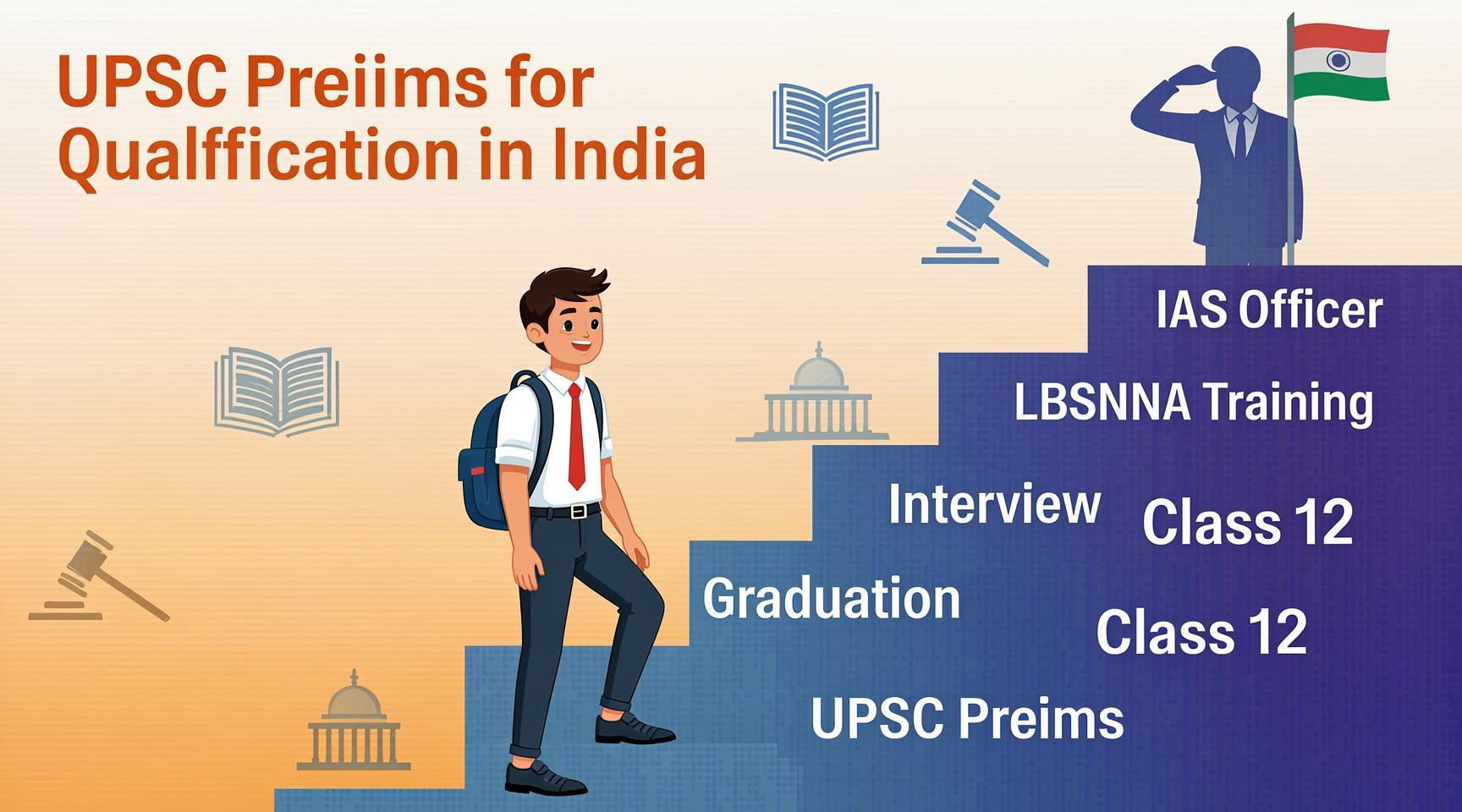
To become an IAS officer in India, you must clear the UPSC Civil Services Exam process, which is conducted in three stages:
- Stage 1: Civil Services Preliminary Examination (Prelims)
- An objective-type screening test consisting of two papers: General Studies (GS) and Civil Services Aptitude Test (CSAT).
- Qualifying in nature; marks are not counted for the final merit list.
- Stage 2: Civil Services Main Examination (Mains)
- A descriptive written exam consisting of 9 papers, including one Essay paper, 4 General Studies papers, 2 Optional Subject papers, and 2 qualifying language papers.
- Stage 3: Personality Test (Interview)
- Candidates who clear Mains are called for a personal interview by the UPSC board.
- The final merit list is prepared based on the combined marks of Mains and the Interview.
Upon clearing all three stages, selected candidates undergo rigorous training at the Lal Bahadur Shastri National Academy of Administration (LBSNAA) in Mussoorie before being allocated their respective cadres and postings.
IAS Preparation Strategy for Beginners (After 12th)
If you are starting your preparation right after 12th, here is a roadmap to follow during your graduation:
- Read NCERTs (Class 6 to 12): Build your foundation by reading NCERT textbooks for History, Geography, Polity, Economy, and Science. These books are simple, reliable, and directly relevant to the UPSC syllabus.
- Read a Daily Newspaper: Develop a habit of reading a standard newspaper (like The Hindu or The Indian Express) daily. Focus on national issues, government policies, and international relations.
- Limit Your Sources: Do not buy a dozen books for one subject. Stick to limited, recommended standard sources and revise them multiple times.
- Daily Answer Writing: The UPSC Mains exam tests your ability to write fast and analytically. Start practicing answer writing daily, even if it’s just a few hundred words.
- Take Mock Tests: Once you have covered 50-60% of the syllabus, start attempting Prelims mock tests to gauge your preparation and improve your accuracy.
- Consistency is Key: Top recommend consistency over intense cramming. Studying 6 to 8 hours a day consistently is far better than studying 14 hours for a week and burning out.
Salary and Perks of an IAS Officer
The prestige that accompanies being an IAS officer is also enhanced by the generous salary. According to the 7th Pay Commission, a Junior level IAS officer starts his career on a basic pay of Rs. 56,100 per month, which is at the pay scale level 10.
Apart from the basic salary, IAS officers also receive a variety of other perks, including Dearness Allowance (DA), House Rent Allowance (HRA), and Travel Allowance (TA), besides getting official transportation, housing provided by the government, and access to medical services. The salary and perks increase significantly with the passage of time through promotions.
FAQ
Question: Can I become IAS directly after 12th?
Answer: No, you cannot become an IAS officer directly after Class 12. A bachelor’s degree from a recognized university is mandatory to appear for the UPSC Civil Services Examination. However, you can start preparing for the exam right after 12th during your graduation.
Question: What is the age limit for IAS?
Answer: The minimum age requirement to appear for the UPSC Civil Services Exam is 21 years, and the upper age limit for general category candidates is 32 years. Age relaxations apply for OBC (35 years), SC/ST (37 years), and PwD categories.
Question: Which graduation course is best for IAS?
Answer: There is no fixed stream for UPSC. However, Arts/Humanities subjects like History, Political Science, Geography, and Economics are widely preferred because they overlap with the UPSC General Studies syllabus. Science and Commerce students can also clear the exam with proper preparation.
Question: What is the starting salary of an IAS officer?
Answer: An IAS officer starts at a basic pay of ₹56,100 per month at Pay Level 10 under the 7th Pay Commission, along with additional allowances like DA, HRA, and TA, which significantly increase the total in-hand salary.