Introduction
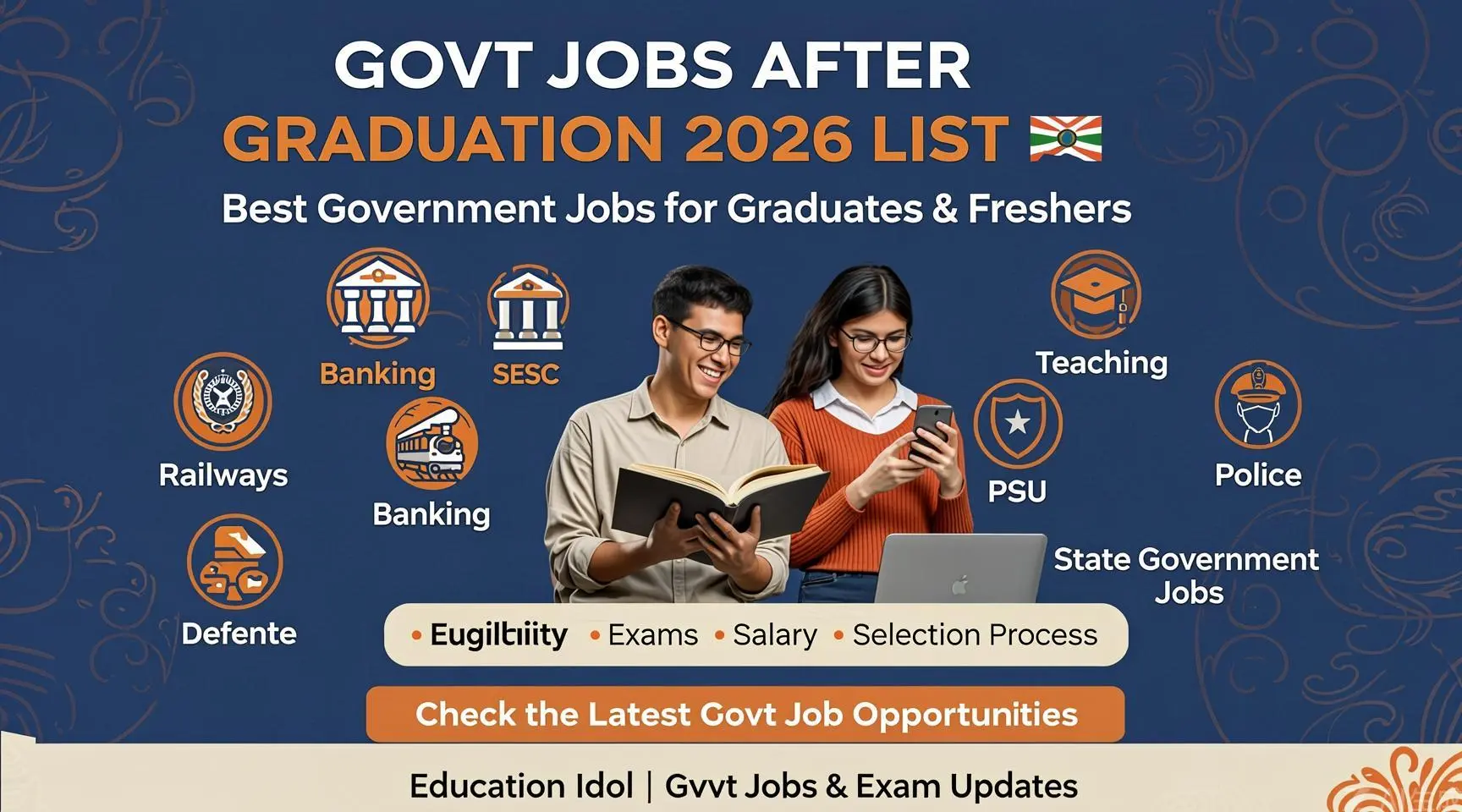
In case you’ve just completed your graduation and are uncertain about the direction in which you would like to proceed, the following list for govt jobs after graduation 2026 may help you get started. Govt jobs continue to be one of the most reliable career options in India due to their assured job security, fixed salary, pension, allowances, and well-defined promotion ladder. As a fresher or final year student, in 2026, there is a plethora of job opportunities in UPSC, SSC, banking, railways, defense, teaching, police, state govt, and PSUs.
The article below provides all the necessary information regarding the government jobs after graduation 2026 in very easy language. You can get detailed information such as eligibility criteria for each job, the exam you need to give, salary range, selection procedure, and complete guidance as to how you can locate the vacancy and apply. The salary figures mentioned above are just indicative and general category-based; number of vacancies, age limit, and salary may vary each year with each recruitment notification.
Why Government Jobs Are Popular After Graduation
- Job security — permanent employment with protection against arbitrary termination.
- Structured pay and growth — fixed pay levels under the 7th Central Pay Commission (CPC) or the respective state pay rules, with regular increments and promotions.
- Benefits and allowances — Dearness Allowance (DA), House Rent Allowance (HRA), travel, medical, and pension/NPS benefits.
- Work-life balance — generally predictable working hours and leave policies.
- Wide eligibility — many government jobs for freshers accept any graduate, so your exact degree stream is often less important than clearing the exam.
Top Government Jobs After Graduation in 2026
| Category | Example Posts | Key Exam / Route |
|---|---|---|
| Civil Services (UPSC) | IAS, IPS, IFS, IRS | UPSC Civil Services Examination (CSE) |
| SSC (Staff Selection Commission) | Assistant Section Officer, Inspector, Auditor, Tax Assistant | SSC CGL |
| Banking | Probationary Officer (PO), Clerk | IBPS PO/Clerk, SBI PO/Clerk |
| Railways | NTPC Graduate posts, JE, ALP | RRB NTPC, RRB JE |
| Defence | Officer entry (Army/Navy/Air Force) | CDS, AFCAT, CAPF AC |
| Teaching | Assistant Professor, Teacher | UGC NET, CTET/State TET, KVS/NVS |
| Police | Sub-Inspector, Constable (graduate posts) | State Police SI, CAPF |
| State Government | State PSC, Group B/C posts | State PSC exams |
| PSUs | Engineer, Executive trainee | GATE-based recruitment, direct PSU exams |
This is your broad govt jobs after graduation 2026 list; the sections below explain each in detail.
Job-wise Eligibility and Exam Details
1. UPSC Civil Services (IAS, IPS, IFS, IRS)
- Educational eligibility: A bachelor’s degree in any discipline from a recognised university. Final-year students can also apply provisionally.
- Age limit: Usually 21–32 years for the general category (relaxation for OBC/SC/ST/PwD/Ex-servicemen). Verify the exact range in the annual notification.
- Exam: UPSC Civil Services Examination — Preliminary (objective), Mains (written), and Interview/Personality Test.
2. SSC CGL (Combined Graduate Level)
- Educational eligibility: Bachelor’s degree in any stream (some posts require specific subjects, e.g., Statistics for certain roles).
- Age limit: Varies by post—roughly 18–32 years depending on the post; check the notification for the exact band for your chosen post.
- Exam: SSC CGL—Tier 1 (objective), Tier 2, and further stages/typing or data-entry skill tests as applicable.
3. Banking: IBPS & SBI PO / Clerk
- Educational eligibility: Graduation in any discipline (computer knowledge often preferred).
- Age limit: PO typically 20–30 years; Clerk typically 20–28 years (general category, varies by bank and notification).
- Exam: IBPS PO/Clerk, SBI PO/Clerk — Preliminary, Mains, and interview (PO) / local-language test (Clerk).
4. Railways: RRB NTPC, JE, ALP
- Educational eligibility: NTPC graduate-level posts require a degree; JE and ALP/Technician posts accept diploma/ITI or engineering qualifications as per the post.
- Age limit: Commonly 18–33 years for graduate posts (varies by post and category).
- Exam: Computer-Based Test (CBT) stages conducted by the Railway Recruitment Board (RRB), followed by document verification and medical standards.
5. Defence Officer Entry: CDS, AFCAT, CAPF AC
- Educational eligibility: Bachelor’s degree (specific stream requirements differ for Army, Navy, Air Force, and technical branches).
- Age limit: Varies by academy and branch — roughly 19–25 years for many entries; check the exact academy-wise limit.
- Exam: UPSC CDS, AFCAT (Air Force), and UPSC CAPF Assistant Commandant for paramilitary forces.
6. Teaching: UGC NET, CTET, KVS/NVS
- Educational eligibility: For Assistant Professor, a master’s degree with the required percentage; for school teaching, graduation plus B.Ed (or D.El.Ed for primary) and qualifying the relevant TET.
- Age limit: UGC NET has no upper age limit for Assistant Professor eligibility (JRF has its own limit); CTET has no age limit; school-recruitment age limits vary by organisation.
- Exam: UGC NET, CTET/State TET, KVS/NVS/EMRS recruitment exams.
7. Police & CAPF: Sub-Inspector and Similar Posts
- Educational eligibility: Graduation in any discipline for Sub-Inspector and Assistant Commandant level posts.
- Age limit: Varies widely by state and force — commonly around 19–28 years for SI posts; check the specific state notification.
- Exam: State police recruitment exams (written + Physical Efficiency Test + Physical Measurement Test) and UPSC CAPF AC for central forces.
8. State Government: State PSC & Group B/C
- Educational eligibility: Graduation for most Group B and gazetted posts; some Group C posts may require 12th or specific qualifications.
- Age limit: Varies by state—commonly 21–38 years with state-specific relaxations.
- Exam: State Public Service Commission (PSC) exams and state-level selection boards.
9. PSUs: Engineer and Executive Trainee
- Educational eligibility: Engineering degree (B.E./B.Tech) for technical posts; MBA/CA/CMA or other degrees for management/finance roles.
- Age limit: Varies by company and discipline; often around 21–30 years.
- Exam: GATE score-based shortlisting, followed by group discussion and interview, or a company-specific online test.
Salary / Pay-Level Overview
Salaries below are indicative and based on the 7th CPC pay matrix for central government posts; state pay scales and PSU packages may differ. Actual take-home includes basic pay plus allowances such as DA, HRA, and transport allowance.
| Job Category | Indicative Pay Level | Indicative Monthly (approx.) |
|---|---|---|
| UPSC Civil Services (entry) | Level 10 | ₹56,100 basic + allowances |
| Banking PO (IBPS/SBI) | — | ₹45,000 – ₹65,000 (gross, incl. allowances) |
| Banking Clerk (IBPS/SBI) | — | ₹30,000 – ₹40,000 (gross, incl. allowances) |
| SSC CGL Group B/C posts | Level 4 – 8 | ₹25,500 – ₹47,600 basic (varies by post) |
| RRB NTPC graduate posts | Level 2 – 6 | ₹19,900 – ₹35,400 basic (varies by post) |
| Defence Officer (Lieutenant/entry) | Level 10 | ₹56,100 basic + Military Service Pay |
| Assistant Professor (entry) | Academic Level 10 | ₹57,700 basic (UGC scale) |
| PSU Engineer/Executive trainee | — | ₹50,000 – ₹1,60,000 (IDA scale, varies by company) |
Selection Process (Simplified)
Most Sarkari Naukri after graduation follow a similar multi-stage pattern:
- Online application — register on the official portal, fill the form, upload documents, and pay the fee.
- Written/CBT exam — preliminary (screening) and/or mains (detailed) computer-based tests.
- Skill/descriptive test — typing, data-entry, or descriptive papers where applicable.
- Interview / Personality Test — for gazetted and officer-level posts.
- Document verification — check original certificates, category, and eligibility.
- Medical / Physical tests — for defence, police, and railway operational posts.
- Final merit list — based on combined scores, followed by appointment.
Best Government Exams for Graduates
If you are building a focused strategy, prioritise these exams by popularity and frequency:
- UPSC Civil Services Examination: the top choice for IAS/IPS aspirants.
- SSC CGL: high volume of graduate posts across central ministries.
- IBPS PO / SBI PO: banking officer roles with regular annual cycles.
- IBPS Clerk / SBI Clerk: clerical roles, ideal for freshers.
- RRB NTPC: graduate-level railway posts.
- CDS / AFCAT: officer entry into the armed forces.
- State PSC exams: state-level administrative and allied services.
- UGC NET: entry into academia as Assistant Professor or JRF.
How to Find and Apply
- Bookmark official portals: upsc.gov.in, ssc.gov.in, ibps.in, sbi.co.in, indianrailways.gov.in, and your state’s PSC/recruitment board.
- Track notifications: Use official employment newspapers (e.g., Employment News / Rozgar Samachar) and verified government job portals.
- Read the full notification PDF before applying — check eligibility, age, vacancies, fee, and dates.
- Apply within the window on the official link only; avoid third-party agents.
- Keep documents ready: scanned photo, signature, mark sheets, ID proof, and category certificate.
Always verify vacancies, dates, eligibility, and fees through the official notification. Avoid unverified lists that quote exact vacancy numbers or deadlines without an official source.
Preparation Strategy
- Master the common syllabus: Most graduate-level exams test Quantitative Aptitude, Reasoning, English, and General Awareness — build strong fundamentals in these.
- Follow current affairs daily: National/international news, government schemes, budgets, and sports are heavily tested.
- Practise mock tests and previous-year papers under timed conditions.
- Choose 2–3 target exams rather than attempting everything; overlap in syllabus makes this efficient.
- Plan by stage: clear the preliminary screening first, then intensify mains/interview preparation.
- Stay consistent: a 6–12 month steady routine usually outperforms short bursts of effort.
Frequently Asked Questions (FAQs)
Q1. Which government job is best after graduation in 2026?
The “best” depends on your goal. UPSC Civil Services is the most prestigious; banking (IBPS/SBI PO) offers fast, regular recruitment; SSC CGL provides a large number of central posts; defence (CDS/AFCAT) suits those wanting a service career.
Q2. Can final-year students apply for government jobs after graduation?
Yes, for many exams (such as UPSC CSE and some banking/PSC posts) final-year students can apply, provided they submit proof of graduation at the document-verification stage. Confirm this in each notification.
Q3. What is the minimum qualification for most graduate government jobs?
A bachelor’s degree in any discipline is the common minimum. Some technical posts require specific streams (engineering, statistics, law, etc.).
Q4. Is there an age relaxation for reserved categories?
Yes. OBC, SC/ST, EWS, PwD, and ex-servicemen generally receive upper-age relaxation and additional attempts where applicable. Exact limits are given in each notification.
Q5. Do I need coaching to clear these exams?
Not necessarily. Self-study with standard books, current-affairs sources, and regular mock tests works for many candidates. Coaching can help with structure but is not mandatory.
Q6. How much do government jobs pay after graduation?
Entry pay varies by post and level. As a broad indicator, central graduate posts range from around ₹25,000 to ₹56,000+ per month in basic pay (before allowances), with officer-level and PSU roles at the higher end.
Q7. How do I avoid fake job alerts?
Apply only through official websites, ignore agents promising selection, and cross-check every vacancy, date, and fee against the official notification PDF.
Conclusion
The list of govt jobs after graduation 2026 has a lot to offer to freshers. Whether you wish to join civil services, banking, railways, defence, teaching, police, state services, or PSUs, getting a degree in almost all fields is an opportunity in itself; the key here lies in regular and exam-specific preparation along with proper and timely applications.
Just select two to three exams as per your strengths and interests, make a schedule based on the syllabus of those exams and keep track of current affairs. Make sure you bookmark the official websites and read notifications thoroughly without taking any chances regarding vacancies and deadlines. The future of a promising career with the government sector awaits you in 2026!